
Quick Summary
Fixing a stuck electric gate requires a methodical diagnostic approach to resolve power failures, sensor misalignments, and mechanical jams without risking personal injury or motor burnout. Homeowners can safely troubleshoot many common issues by checking breakers, cleaning safety photo-eyes, and disengaging the manual release clutch to check for physical track binding. After reading this guide, you will know how to perform basic diagnostic checks and when to contact the licensed technicians at Ironworks Gate Co. for same-day repair of complex mechanical or electrical failures.
Fixing a Stuck Electric Gate – Troubleshooting and Repair Guide
Fixing a stuck electric gate starts with identifying whether the failure is electrical, optical, or mechanical. While automated gates provide security and daily convenience, they are heavy motorized machines under mechanical tension. Forcing a gate that refuses to move or repeatedly cycling your remote control often turns a simple, low-cost fix into a major repair.
The U.S. Consumer Product Safety Commission (CPSC) has identified automatic gates as a recurring injury hazard and estimated about 300 emergency-room injuries per year during 2011-2015. A methodical diagnostic approach protects both your equipment and your personal safety.[2]
What to Do First When Your Electric Gate Is Stuck
When an automated driveway gate stops mid-cycle, stays stuck open, or refuses to budge from the closed position, a common reaction is to press the remote repeatedly. Avoid doing this. If the gate has hit a mechanical bind or jumped its track, continuously cycling the motor forces the operator to push against an immovable object. This can strip internal nylon or brass gears, bend mounting brackets, or overheat the motor windings.
Instead, follow this initial four-step checklist:
- Stop cycling the controls: Put the remote down and step away from keypads or wall buttons so nobody accidentally activates the operator while you inspect it.
- Listen and look: Take note of what happens when power is applied. Does the control box click? Does the motor emit a low hum? Are the diagnostic LEDs on the motherboard illuminated?
- Check the physical path: Look along the ground track for sliding gates or around the swing radius for swing gates. Check for stones, packed dirt, fallen tree branches, or debris wedged in the track or hinges.
- Inspect the operator housing: If the motor feels extremely hot to the touch, the system may have entered thermal overload protection to prevent motor burnout.
What You Will Need Before Troubleshooting
Before testing or inspecting an electric gate system, gather a few basic tools and safety items:
- Manual release key or hex tool: The manufacturer-provided key or handle used to disengage the internal drive clutch.
- Clean microfiber cloth: To clean optical safety sensors without scratching the lenses.
- Standard flashlight: To inspect dark control boxes, gearboxes, and track channels.
- Durable work gloves and eye protection: Heavy gates can pinch, and outdoor control boxes often harbor spiders or wasps.
- Multimeter (optional): Helpful if you are comfortable safely testing basic low-voltage circuits or battery backup terminals.
As technicians at Ironworks Gate Co. emphasize, derailment and structural failure represent real risks during troubleshooting. ASTM International highlighted gate-derailment and falling-gate incidents as a workplace safety issue in California. Never place your body in the fall path of an unguided or off-track gate panel.[1]
Step 1: Check the Breaker, Fuses, and Power Supply
Need fixing a stuck electric gate?
We’re available now - call for a fast, free estimate.
Complete power loss is a frequent reason an automatic gate fails to respond. Driveway gates are exposed to outdoor elements, electrical utility fluctuations, and sudden surges that can trip breakers or blow low-voltage fuses.
- Check the main electrical panel and subpanel: Locate the dedicated breaker for the gate system. If the breaker has tripped to the middle position, switch it firmly to “OFF” and then back to “ON.”
- Check the GFCI outlet and disconnect switch: Many outdoor operators plug into a dedicated weatherproof GFCI outlet or include an external toggle switch on the operator chassis. Press the GFCI reset button if it has tripped.
- Inspect internal control board fuses: Turn off the main power, open the operator control box, and locate the small glass cylinder or blade-style automotive fuses on the motherboard. A blackened fuse or broken filament indicates an overcurrent surge that requires fuse replacement.
- Diagnose thermal lock vs. motor failure: If the motor attempted multiple heavy cycles, an internal thermal overload switch may have engaged to prevent damage. Allow the motor to cool down before attempting another cycle. If the motor remains unresponsive after cooling and power is verified, internal electrical components may have failed.
Step 2: Inspect and Clean Safety Sensors
If your electric gate is stuck open and will not close, misaligned or dirty photo-eye sensors are a common cause. Gate operators are built with safety circuits designed to stop or reverse gate movement if an obstacle interrupts the infrared light beam between the sender and receiver.
- Wipe the sensor lenses: Outdoor photo-eyes attract dirt, cobwebs, sprinkler hard water spots, and insects nesting inside the housing. Gently clean both lenses with a dry microfiber cloth.
- Check sensor status lights: Most safety sensors feature an indicator LED on both the transmitter and receiver. A solid light normally confirms proper alignment and power. A flickering or dark LED indicates that the beam is broken, out of alignment, or unpowered.
- Verify line-of-sight alignment: Over time, vibrations from gate operation, wind, or landscaping equipment can knock sensor brackets slightly off-center. Loosen the mounting bracket screws slightly, adjust the angle until the status LED turns solid, and tighten the hardware down firmly.
- Account for sunlight glare: Low-angle morning or evening sunlight shining directly into the receiver lens can blind the sensor, tricking the control board into detecting an obstruction. Installing a small shade hood over the receiver can resolve this issue.
Step 3: Safely Disengage the Manual Release
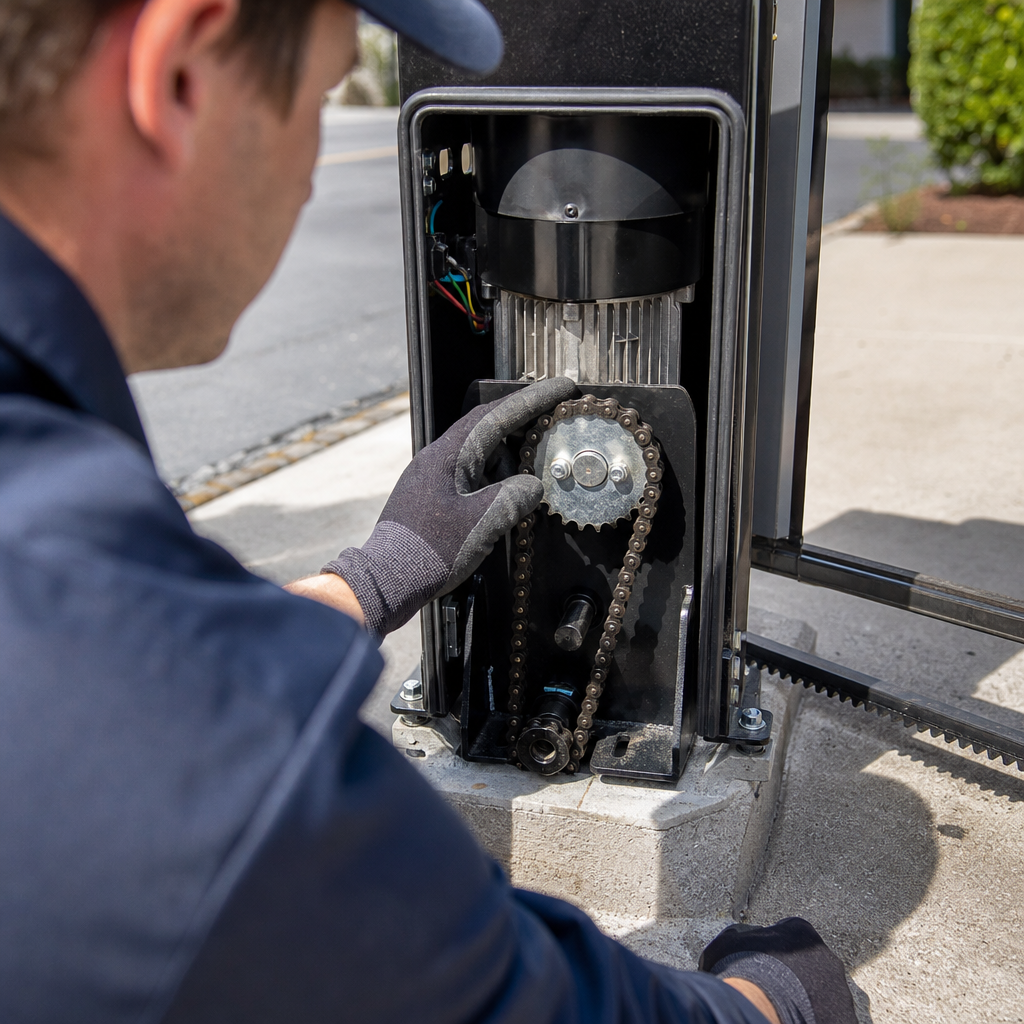
When the control board receives power and safety sensors are clear, but the gate still refuses to move, decoupling the gate from the motor operator allows you to isolate electrical issues from physical binding.[3]
- Locate the manual release mechanism: Depending on the brand (such as LiftMaster, DoorKing, FAAC, or BFT), this will be a keyed lock cylinder, a twist handle, or a pull cord with a cotter pin.
- Unlock and disengage: Insert the release key, turn the lock, and pull the lever to release the internal gearbox clutch or swing arm pivot pin.
- Test manual travel by hand: Gently push the gate panel along its opening and closing stroke. A well-installed sliding or swing gate should glide with minimal physical effort.
- Feel for mechanical drag: If the gate binds, scrapes against the driveway, or catches at a specific point in its travel, inspect the hinges, guide rollers, and track. Never force a stuck gate; pushing against a jammed mechanical linkage can warp the frame or crack hinge posts.
Step 4: Stop if the Gate Hums, Jams, or Is Off Track
Need fixing a stuck electric gate?
We’re available now - call for a fast, free estimate.
Certain symptoms indicate structural or heavy mechanical failures that should not be forced or operated under electrical power.
- Motor hums without physical movement: If you activate the gate and hear a steady electrical hum from the operator box while the gate remains stationary, the drive train is locked or the motor’s start capacitor has failed. Shut off power immediately. Leaving power applied while the motor is stalled can damage internal components.
- Sliding gate has jumped the track: If the bottom v-groove wheels have derailed from the ground track, the entire structural balance of the gate is compromised. Do not attempt to slide it by hand or use the motor. Derailment puts extreme lateral pressure on the top guide rollers, creating an immediate risk of the heavy panel falling over.
- Severe hinge binding or arm deflection: On swing gates, bent operator arms or seized heavy-duty hinges can stall the motor. According to installation specialists at Ironworks Gate Co., operating a swing gate with seized hinges can damage the mounting hardware on masonry or steel posts.
Electric Gate Troubleshooting Quick Reference
Use this summary table to quickly diagnose symptoms and determine the appropriate action.
| Observed Symptom | Probable Root Cause | Recommended Action |
|---|---|---|
| Gate is stuck fully open; will not close | Obstructed or misaligned photo-eye sensors | Clean sensor lenses and adjust bracket angles until the alignment LED is solid. |
| Gate does not respond; no lights on board | Tripped circuit breaker, blown fuse, or GFCI trip | Reset the primary breaker, test the GFCI outlet, or replace blown control board fuses. |
| Motor hums but gate does not move | Blown start capacitor or seized mechanical drive | Turn power off immediately; check manual movement with clutch disengaged. |
| Gate stops halfway through its cycle | Limit switch drift, track obstruction, or low battery backup | Clear physical track debris; adjust limit settings; inspect battery backup. |
| Gate moves slowly and groans loudly | Dry hinge bearings, seized rollers, or worn chain | Lubricate hinges and track wheels with suitable lubricant; check chain tension. |
Automatic Driveway Gate Repair and Maintenance Considerations
Routine wear and tear is normal for automated gate hardware, which operates outdoors in direct sun, rain, and fluctuating temperatures. As general maintenance advice, the following upkeep practices help support reliable operation:
- Regular lubrication: Apply a high-grade white lithium grease or non-greasy silicone lubricant to hinge pivot points, guide rollers, and drive chains according to manufacturer recommendations. Avoid heavy motor oil or standard WD-40, which attract dirt and grit into roller bearings.
- Pest prevention: Ant colonies, spiders, and wasps frequently nest inside warm control boxes. Keep weatherproof box gaskets sealed to protect circuit boards.
- Limit switch adjustments: If your gate stops short of closing or makes hard contact with the catch post, recalibrate the travel limits according to manufacturer specifications.
- Capacitor maintenance: Run capacitors on AC motors degrade over time, particularly in hot climates, which can reduce the torque needed to move the gate.
Frequently Asked Questions About Stuck Electric Gates
Why is my electric gate stuck open and ignoring remote commands?
An electric gate stuck open is often caused by dirty, blocked, or misaligned safety photo-eyes. The system interprets a broken infrared beam as an obstacle in the driveway and holds the gate open to prevent property damage or injury. Clean the lenses and verify alignment before checking electrical connections.
How do I manually open an electric gate when stuck?
To manually open a stuck gate, locate the manual release clutch on the operator chassis. Insert the manufacturer release key or hex wrench, turn the lock to disengage the internal drive mechanism, and slide or swing the gate open slowly by hand. Never force a gate that resists manual pressure.
Why does my gate motor hum when I activate it?
A humming motor indicates that the operator is receiving electrical power, but the drive shaft cannot turn. This is commonly caused by a failed capacitor, an internal mechanical jam, seized hinge bearings, or a gate that has come off its track. Cut the power immediately to avoid motor damage.
How do I reset my automatic driveway gate motor?
Turn off the main circuit breaker supplying the gate, wait a short period to allow residual power to drain, and turn the breaker back on. Some operators also feature a dedicated reset button inside the enclosure that must be pressed after a physical stall event.
When should I stop troubleshooting and call a professional technician?
The team at Ironworks Gate Co. advises that you stop troubleshooting immediately if the gate has derailed from its track, if structural welds on hinges or posts are cracked, if the motor sparks or smells of burning electrical insulation, or if you suspect high-voltage wiring issues inside the main power feed.
Need fixing a stuck electric gate?
We’re available now - call for a fast, free estimate.
Sources
- [PDF] Petition File No. 605 Cal/OSHA Evaluation – dir.ca.gov (2024)
- National Electronic Injury Surveillance System (NEISS) – CPSC – cpsc.gov
- [PDF] Petition File No. 605 Staff Evaluation – dir.ca.gov
Related reading: Sagging Gate Repair | Call Now-10% Off | On-Site in 60 Minutes | Free Estimate
Related reading: Swing Gate Operators – 10% Off & Free Estimate – Same-Day Service
Frequently Asked Questions
What should I do if my electric gate is stuck during a power outage and I do not have the manual release key?
If you do not have the key, check whether your operator model allows you to unbolt the swing arm pivot pin or release a chain bracket with basic hand tools. Never attempt to force the gate panel open with a pry bar, as this will destroy the internal drive gears. Ironworks Gate Co. can dispatch a technician to safely decouple the mechanical drive and provide a replacement release key.
How can I tell if my gate is stuck due to a bad capacitor rather than a burned-out motor?
A bad start capacitor typically causes the motor to emit a steady hum without turning, even though the uncoupled gate slides or swings smoothly by hand. A burned-out motor is usually completely silent, repeatedly trips the main circuit breaker, or gives off a strong burning odor. The technicians at Ironworks Gate Co. can test the capacitor's electrical ratings to determine if a simple part replacement will restore operation.
Why does a failing battery backup cause an electric gate to freeze mid-cycle?
Aging backup batteries often maintain adequate surface voltage at rest but suffer severe voltage drop under the high electrical load of gate movement. When the voltage collapses mid-stroke, the control board interprets this as a power loss or stall event and immediately halts the gate.
About the author
 |
David Caldwell David is a technical writer specializing in home services and automated access systems. With over a decade of experience covering residential and commercial property maintenance, he translates complex gate repair concepts and pricing structures into clear, actionable advice. He holds a B.A. in Communications from California State University, Northridge. |
Gate not opening, off track, or opener dead?
We’re available now - call for a fast, free estimate.
Call Now - Free Estimate