
Quick Summary
Understanding what causes gate control board failure is essential when automated entry systems suffer from power loss, blown fuses, or erratic operational cycles. Diagnostic specialists at Ironworks Gate Co. identify high-voltage electrical transients, surge propagation along low-voltage sensor wiring, moisture ingress, and thermal stress as primary drivers of circuit damage. Property owners can utilize targeted troubleshooting and schedule a professional diagnostic inspection to pinpoint specific circuit faults before committing to expensive hardware replacement.
Potential Causes and Diagnostic Considerations for Gate Control Board Failure
When an automated driveway gate stops responding, property owners often consider potential electrical or mechanical issues. While mechanical resistance can contribute to motor and control-system stress, its prevalence relative to other causes is not established by the available neutral evidence.
As technicians at Ironworks Gate Co. observe, understanding gate control board issues requires evaluating both physical operator conditions and electrical environments. Supported causal mechanisms include lightning or electrical transients, PCB-layout-related voltage spikes, and transients entering through connected sensor or low-voltage wiring. Other conditions, such as mechanical friction, limit-switch misalignment, ambient heat, moisture, capacitor aging, and motor stalls, represent possible mechanisms or diagnostic considerations.[1] See also Gate Repair Cost & Pricing in Northridge – Call Now-10% Off – On-Site in 60 Minutes – Free Estimate.
Documented Mechanisms and Diagnostic Considerations
Gate operators operate in outdoor environments and handle regular physical loads. Diagnostic evaluations should distinguish between supported causal mechanisms and potential contributing factors:
1. Electrical Transients and PCB Voltage Spikes
Documented mechanisms of board failure include high-voltage transients from lightning or power grid disturbances, as well as PCB-layout-related voltage spikes. These electrical events can cause voltage breakdown across microcontrollers, rectifiers, and other sensitive circuit board components. Utility brownouts and grid instability also serve as diagnostic considerations during electrical troubleshooting.
2. Surges Through Connected Sensor and Low-Voltage Wiring
High-voltage transients can enter control boards through external low-voltage sensor and accessory wiring. Transients from nearby lightning strikes can propagate along extended field runs, such as buried loop detectors, safety photo eyes, edge sensors, and keypads, introducing voltage spikes directly to low-voltage microprocessor inputs.[2]
3. Mechanical Resistance and Motor Amperage
Mechanical resistance is a possible mechanism and diagnostic consideration. When hinges, tracks, or rollers bind, drive motors require additional current to move the gate. While mechanical resistance can contribute to motor and control-system stress, its prevalence relative to other causes is not established by the available neutral evidence.
4. Limit Switch Misalignment and Motor Stalls
If a limit switch fails to activate correctly, an operator may drive the gate into physical stops, creating a motor stall condition. Motor stalls represent a diagnostic consideration that can produce elevated current and place electrical stress on control circuits in the absence of responsive cutoff mechanisms.
5. Moisture Ingress and Pest Activity
Moisture ingress and condensation inside unsealed enclosures are diagnostic considerations that can promote corrosion across circuit traces. Regarding pests, the research brief found no authoritative neutral evidence specifically documenting insect-related gate control-board failures, though debris and contamination are common points of visual inspection.
6. Environmental Heat and Capacitor Aging
Elevated ambient operating temperatures and long-term thermal exposure are diagnostic considerations associated with capacitor aging. Over time, capacitor degradation may contribute to erratic operation, logic resets, or board instability.
Signs of a Potential Gate Control Board Issue
Symptoms such as erratic operation, resets, sensor faults, visible damage, and loss of response are non-specific and require testing of the complete system to identify the root cause.
- Loss of response: The operator is completely unresponsive or status indicators remain inactive.
- Relay activation without movement: Control relays click upon receiving a command, but no drive output occurs.
- Visible damage or odor: Discoloration, burn marks, or heat-related odors on the circuit board assembly.
- Repeated fuse openings: Fuses open immediately upon replacement or system activation.
- Erratic cycles and logic resets: The system stops mid-cycle, resets unexpectedly, or fails to retain programmed settings.
How to Test and Troubleshoot a Gate Control Board
Need what causes gate control board failure?
We’re available now - call for a fast, free estimate.
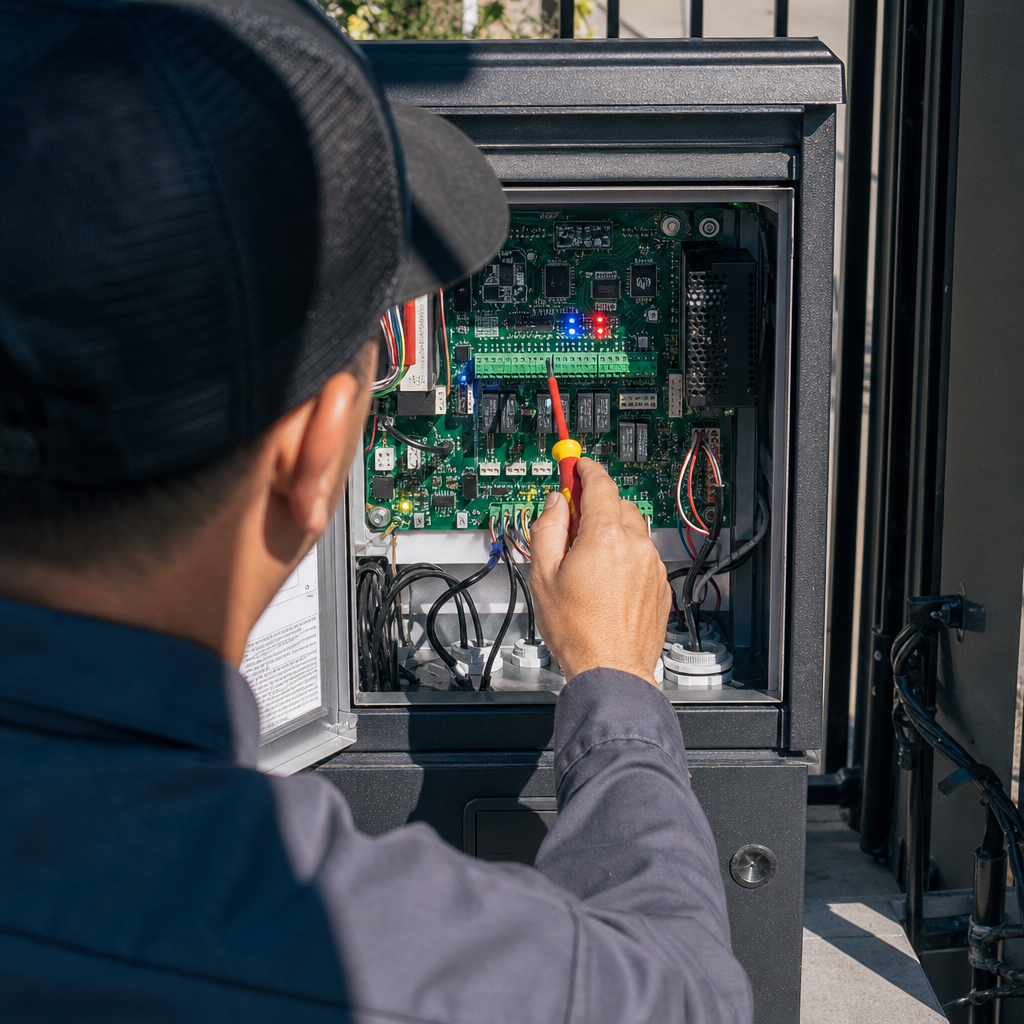
Safety Warning: Electrical measurements, accessory isolation, and any safety-circuit testing must follow the applicable manufacturer documentation and be performed by a qualified technician.
- Inspect the Board Visually: Disconnect power following safety procedures and examine the board for signs of localized burning, trace delamination, moisture, or physical contamination.
- Verify Power and Transformer Output: Measure incoming line voltage and low-voltage secondary outputs with a multimeter to verify power supply parameters specified by the manufacturer.
- Check Onboard Fuses: Test onboard and accessory fuses to confirm continuity and check for overcurrent conditions.
- Isolate External Accessories: Disconnect field accessories and test or jumper safety circuits strictly in accordance with manufacturer documentation to isolate external wiring faults from internal board issues.
- Check Diagnostic Readouts: Observe diagnostic LEDs or display error codes and compare them against manufacturer technical documentation to identify specific fault codes or active interlocks.
Repair vs. Replacement Considerations
Guidance regarding whether to repair or replace a gate control board depends on the nature and severity of the fault:
- Repair: Repair may be reasonable for localized damage, minor connector or terminal issues, or obsolete boards where suitable replacement units are no longer commercially available.
- Replacement: Extensive burning, PCB delamination, severe corrosion, or multiple failed components may favor complete board replacement to ensure proper operation and adherence to safety standards.
Protecting Gate Control Boards
To support system reliability and protect gate electronics, standard maintenance and installation practices recommended by Ironworks Gate Co. include:
- Reduce Mechanical Resistance: Regularly inspect and maintain gate hinges, rollers, and tracks to reduce unnecessary motor load and electrical strain.
- Install Surge Protection: Use appropriate surge suppression devices on primary power inputs and connected low-voltage accessory lines to mitigate transient voltage spikes.
- Seal Enclosure Openings: Seal conduit entries and enclosure penetrations to minimize moisture entry and humidity accumulation.
- Verify Limit Settings: Periodically check limit switch alignment to prevent over-travel and motor stalling against physical stops.
Frequently Asked Questions
What are the signs of a potential gate control board failure?
Signs such as erratic operation, unexpected resets, sensor faults, visible board damage, blown fuses, and loss of response are non-specific indicators that require systematic testing of the complete gate system.
Can power surges or lightning damage a gate control board?
Yes. Documented mechanisms of board failure include electrical transients from lightning strikes or power grid events entering through main power feeds, as well as transients entering through low-voltage field sensor wiring.
Do insects cause gate control board failure?
While moisture and environmental contamination are recognized diagnostic considerations, the research brief found no authoritative neutral evidence specifically documenting insect-related gate control-board failures.
When should a gate control board be repaired versus replaced?
Board repair may be reasonable for localized damage or obsolete boards where replacements are unavailable. Conversely, extensive burning, delamination, widespread corrosion, or multiple component failures favor complete board replacement.
How can a gate control board be protected from electrical damage?
Protection measures include installing verified surge protection on both main power supplies and low-voltage sensor lines, sealing enclosure conduit entries, and performing regular mechanical maintenance.
Need what causes gate control board failure?
We’re available now - call for a fast, free estimate.
Sources
- Cyber Threat and Vulnerability Analysis of the U.S. Electric … – energy.gov (2016)
- hard-wired control circuitry: Topics by Science.gov – science.gov
Related reading: Gate Repair Pricing Northridge – 10% Off & Free Estimate – On-Site in 60 Minutes
Related reading: Best Heavy Duty Swing Gate Opener – 10% Off & Free Estimate – Same-Day Service
Related reading: Gate Limit Switch Drift Explained – 10% Off & Free Estimate – Same-Day Service
Frequently Asked Questions
How do technicians determine if a gate fault is in the control board or an external accessory?
Technicians isolate the control board by systematically disconnecting external field wiring – such as safety loops, photo eyes, and keypads – and testing the onboard logic with diagnostic jumpers. Ironworks Gate Co. performs complete electrical input and relay testing to confirm whether an external peripheral or the main circuit board caused the system failure.
Why does a gate control board need surge protection on low-voltage sensor lines?
Long, underground field wiring for safety sensors and keypads acts as a conductor for nearby lightning transients, channeling high-voltage spikes directly into low-voltage microprocessor circuits. Adding dedicated surge suppressors to both the primary power feed and accessory loops protects sensitive board inputs from backdoor electrical damage.
Can a malfunctioning gate control board be repaired instead of replaced?
Localized damage such as failed relays, minor trace corrosion, or blown terminal connectors can often be repaired to restore functionality without purchasing a new unit. Diagnostic specialists at Ironworks Gate Co. evaluate the extent of component damage to determine if targeted circuit repair is a viable, cost-effective alternative to complete board replacement.
About the author
 |
David Caldwell David is a technical writer specializing in home services and automated access systems. With over a decade of experience covering residential and commercial property maintenance, he translates complex gate repair concepts and pricing structures into clear, actionable advice. He holds a B.A. in Communications from California State University, Northridge. |
Gate not opening, off track, or opener dead?
We’re available now - call for a fast, free estimate.
Call Now - Free Estimate