
Quick Summary
Inductive gate loop detectors function by running an alternating current through buried copper wire to generate an electromagnetic field that senses vehicle metal through resonant frequency shifts. According to technical specialists at Ironworks Gate Co., most sudden loop malfunctions stem from issues like thermal inductance drift, frequency crosstalk, or failed sealant rather than severed underground wiring. Readers will learn how to troubleshoot control module fault codes and test circuit resistance to determine whether a system requires simple recalibration or professional on-site repair.
How Do Gate Loop Detectors Work? Fast Diagnostic Guide
If you want to know how gate loop detectors work and why your gate suddenly stopped responding, the core concept is simple. An insulated wire embedded in the driveway carries an alternating current, creating an active electromagnetic field. When a vehicle drives over that loop, the metal in its frame alters the circuit’s electrical properties. The loop module in your operator housing senses that change and tells the gate to open, pause, or reverse.[2]
According to technicians at Ironworks Gate Co., when an automated gate acts up, property owners often assume the underground wiring is broken and that the driveway must be torn up. In reality, most issues come down to sensitivity drift, frequency crosstalk between adjacent loops, or summer heat expanding the pavement. A few targeted tests at the control panel can usually pinpoint the trouble in minutes.
What Is a Gate Loop Detector?
An inductive loop detector is essentially an underground metal sensor. It consists of a continuous loop of insulated copper wire installed beneath concrete or asphalt, connected back to a detector board inside the gate operator enclosure (such as a LiftMaster, DoorKing, or FAAC unit).[3]
The detector module continuously monitors the electrical frequency running through that buried wire. When nothing is parked over the loop, the circuit stays at a steady baseline frequency. As soon as a car, truck, or golf cart pulls over the cut channel, the metal chassis interacts with the magnetic field, and the detector trips an internal relay that signals the main gate controller.
How an Inductive Loop Detects Vehicles
Need how do gate loop detectors work?
We’re available now - call for a fast, free estimate.
Inductive loops do not rely on optical beams, motion sensors, or mechanical pressure plates. They work through electromagnetic induction:
- Continuous Current: The detector module sends a low-voltage alternating current (usually between 10 kHz and 200 kHz) through the buried loop, creating an active magnetic field above the pavement.
- Eddy Current Generation: When a vehicle enters this field, the metal underside of the vehicle absorbs some of that energy, producing swirling electrical currents known as eddy currents across the vehicle chassis.
- Inductance Drop: These eddy currents create an opposing magnetic field, which lowers the overall inductance of the buried loop.
- Frequency Shift: As inductance drops, the resonant frequency of the circuit rises. The detector module spots this spike against its programmed threshold and fires a contact switch to tell the gate operator what to do.
Presence Mode vs. Pulse (Passage) Mode
Loop detector modules can be configured to process these frequency shifts in two distinct ways:
- Presence Mode: The detector holds its output signal active for as long as a vehicle remains parked over the loop. This setting is standard for safety and reversing loops to prevent a gate from swinging or sliding shut while a car is sitting in the driveway opening.
- Pulse (Passage) Mode: The module sends a momentary pulse signal the moment a vehicle crosses the wire, regardless of how long the vehicle stays parked there. This mode is often used for entry counters, ticket dispensers, or specific access control triggers.
Safety Loop vs. Exit Loop vs. Shadow Loop
A reliable automatic gate system relies on multiple loops positioned at specific distances from the gate leaf to manage traffic safely.
| Loop Type | Standard Location | Primary Role |
|---|---|---|
| Exit Loop (Free Exit) | 25 to 50 feet inside the property line | Detects departing vehicles and signals the gate to open automatically without requiring a remote or keypad code. |
| Safety / Reversing Loop | Just inside and outside the swing or slide path | Prevents the gate from closing on a vehicle sitting in the threshold, or reverses a closing gate if a car enters the path. |
| Shadow Loop | Directly beneath the swing arc of an open swing gate | Used on commercial swing gates to prevent the gate from closing if a vehicle pulls into the blind spot while the gate is open. |
Exit Loops
An exit loop (often called a free exit loop) gives residents and guests hands-free egress. Placed back from the gate, it detects an approaching car and sends an open command so the gate is already swinging or sliding clear by the time the driver arrives at the threshold.
Inside and Outside Safety Loops
Safety loops act as non-contact protection zones. Unlike photo-eye sensors, which only shoot a narrow infrared beam at bumper height, an inductive safety loop blankets the entire roadway lane. If a vehicle stops directly over the safety loop, the gate will stay open until the lane is clear.
Shadow Loops
Shadow loops are specifically designed for swing gates. When a swing gate is fully open, the gate leaf rests directly over the shadow loop area. The control board ignores the metal of the gate arm while opening, but if a vehicle pulls alongside the open leaf, the shadow loop locks the gate in the open position to prevent side-swiping the car.
Why Driveway Loop Detectors Fail
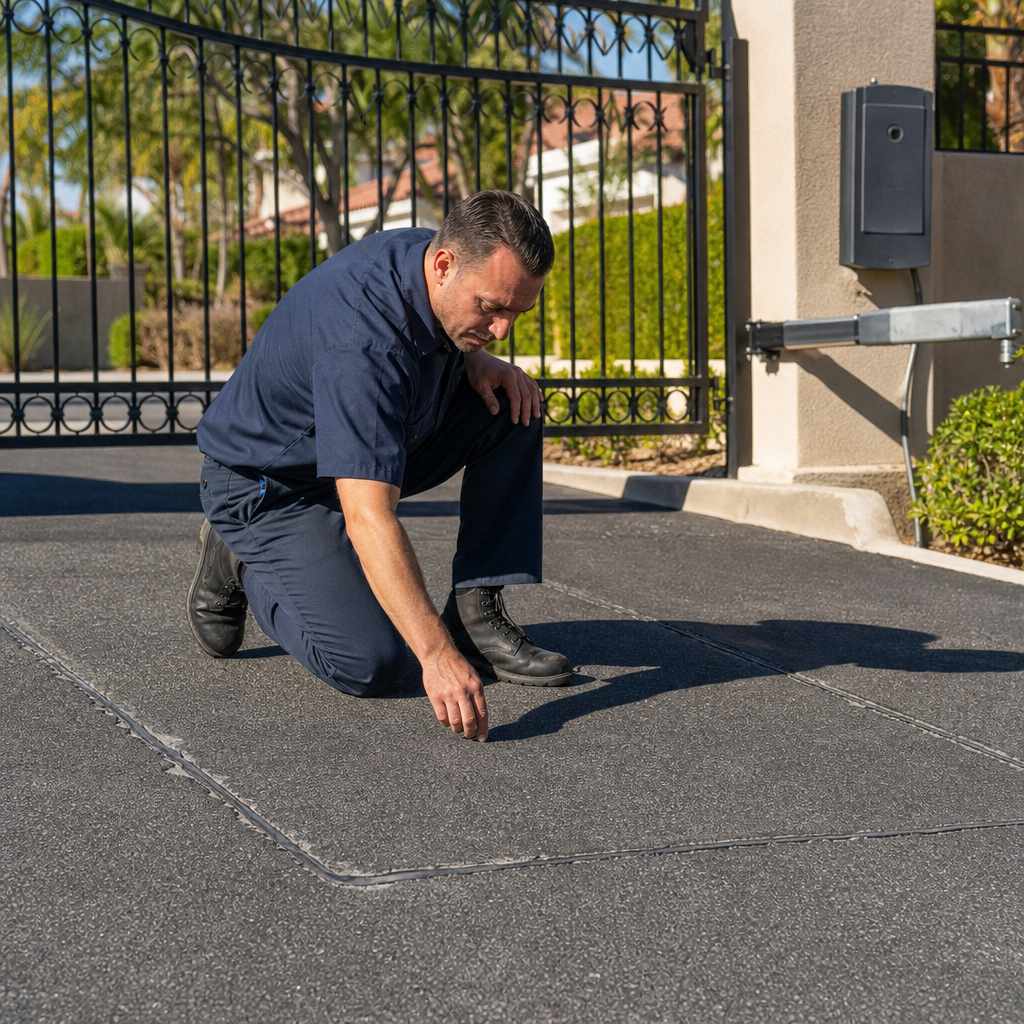
When an automated gate opens on its own, stays open indefinitely, or refuses to let cars out, the loop system is often blamed. Before assuming the underground wire is broken, consider the most common real-world failure points:
Thermal Inductance Drift and Summer Heat
In hot climates, asphalt can easily reach surface temperatures above 140 degrees Fahrenheit. As asphalt expands and softens, the physical geometry of the saw-cut slot changes slightly. This heat also increases the resistance of the copper wire, causing baseline inductance to drift.
If a detector module is calibrated on a cool morning with tight sensitivity thresholds, that afternoon heat shift can cause the module to register a phantom vehicle, locking the gate wide open. Modern digital loop detectors feature automatic frequency tracking to compensate for drift, but older analog modules often require manual frequency readjustment.
Frequency Crosstalk Between Adjacent Loops
When two separate loops (such as an inside safety loop and an outside safety loop) run on the exact same operating frequency and their lead-in cables share a conduit, they can cross-talk. This interference leads to erratic gate cycling, random false triggers, or dropped detection. Most detector modules feature dip switches that let you set each channel to a distinct frequency (Low, Medium-Low, Medium-High, High) to eliminate cross-talk.
Sealant Breakdown and Moisture Intrusion
Driveway loop wire is sealed inside narrow saw cuts using specialized polyurethane or epoxy loop sealant. Over years of vehicle traffic and UV exposure, cheap sealants crack. When rain or sprinkler runoff seeps into the cut, water can contact nicked insulation or corroded splices, dropping the loop’s resistance to ground and causing the detector to lock up in a permanent fault condition.
Sensitivity Setting Imbalance
Every detector module has a sensitivity dial or dip-switch bank. If set too high, the loop can trigger from high-profile vehicles in adjacent lanes, moving gate hardware, or even metallic lawn equipment. If set too low, the loop may reliably detect full-sized SUVs but completely miss lightweight sports cars, motorcycles, or utility trailers.[1]
Troubleshooting and Testing a Gate Loop
Need how do gate loop detectors work?
We’re available now - call for a fast, free estimate.
If you suspect a loop fault, follow these diagnostic steps at the operator cabinet before hiring someone to cut new pavement:
- Check the Module Diagnostic LEDs: Most modules (like Reno A&E, EDI, or DoorKing plug-ins) have diagnostic lights. A steady power LED with a lit detect LED means the module thinks a car is sitting on the loop right now. If the LED flashes rapidly, count the flashes to read the fault code (typically open loop, shorted loop, or large inductance change).
- Change the Operating Frequency: Toggle the module frequency switch to a different channel (for example, from High to Medium-Low). Press the module reset button and see if false triggering stops.
- Test Inductance with an LCR Meter: Disconnect the loop lead-in wires from the detector module. A healthy driveway loop should read between 50 and 500 microhenries (µH). If the reading is zero, the wire is shorted. If the reading is infinite, the loop circuit is severed.
- Test Resistance to Ground (Megohmmeter Test): Measure resistance between one lead of the loop wire and an earth ground rod. A sound loop with intact insulation should read at least 100 megohms. Anything under 10 megohms indicates moisture intrusion or damaged wire casing.
Installation Best Practices: Depth, Turns, and Sealant
According to guidelines from Ironworks Gate Co., when installing a new saw-cut loop in asphalt or concrete, proper technique prevents future service calls:
- Slot Depth: Cuts should be sawed 1.5 to 2 inches deep and roughly 3/16 to 1/4 inch wide. The loop wire needs at least 1 full inch of sealant resting over the top turn to protect it from vehicle tire weight and temperature shifts.
- Corner Cuts (45-Degree Chamfers): Never bend loop wire around a sharp 90-degree corner. The pavement saw must make diagonal 45-degree relief cuts at every corner to prevent pinching or breaking the wire jacket during installation.
- Number of Turns: The total wire turns depend on the perimeter size of the loop. A standard 6×6-foot loop requires 3 to 4 continuous wraps of XLPE-insulated (cross-linked polyethylene, such as Type USE or IMSA spec) copper wire.
- Twisted Lead-In Wires: From the corner where the loop exits the driveway to the gate operator housing, the two lead-in wires must be tightly twisted together (a minimum of 5 to 6 twists per foot). This cancels out magnetic interference along the home-run path, preventing false triggers.
Frequently Asked Questions
Can a gate loop detector pick up bicycles or pedestrians?
Because inductive loops detect changes in electromagnetic fields caused by conductive metal, they do not detect pedestrians. They can detect metal bicycles or aluminum-frame motorcycles if the detector module sensitivity is dialed up high enough, but standard residential settings are usually tuned to filter out lightweight items and focus on cars and trucks.[4]
How deep should loop detector wire be buried?
For saw-cut installations in existing concrete or asphalt, the channel is cut 1.5 to 2 inches deep. For new construction before a concrete pour, pre-formed loops in PVC conduit are tied to rebar and buried 2 to 4 inches below the finished slab surface.
Why does my driveway gate open on its own during hot afternoons?
Thermal inductance drift is the most common cause. As asphalt heats up and expands in the afternoon, the physical loop shifting combined with higher wire resistance changes the circuit baseline. If the detector module does not automatically compensate, it misinterprets this drift as a parked car and signals the gate to open. Retuning the frequency or replacing an aging module with a digital self-tuning unit usually solves the problem.
What does it cost to repair or replace a gate loop?
According to estimates from Ironworks Gate Co., diagnostic testing, sensitivity adjustment, and frequency recalibration typically cost between $150 and $250. Replacing an old detector module runs roughly $200 to $400 including labor. If an underground loop wire is cut or degraded beyond repair, sawing and installing a replacement loop generally ranges from $600 to $1,400 depending on driveway material and conduit distance.
Need how do gate loop detectors work?
We’re available now - call for a fast, free estimate.
Sources
- rosap.ntl.bts.gov › view › dotImplementation of Inductive Loop Signature Technology for … – rosap.ntl.bts.gov (2024)
- Research, Development, and Technology – highways.dot.gov (2000)
- Chapter 1, Traffic Detector Handbook: Third Edition-Volume I – fhwa.dot.gov
- Chapter 2, Traffic Detector Handbook: Third Edition-Volume I – fhwa.dot.gov
Related reading: Residential Vs Commercial Gate Operators – Call Now-10% Off – Same-Day Service – Free Estimate
Related reading: Automatic Gate Troubleshooting | Call Now-10% Off | Same-Day Service | Free Estimate
Related reading: How to Reset Faac Gate Motor – 10% Off & Free Estimate – Same-Day Service
Frequently Asked Questions
Can gate loop detectors be installed under paver or gravel driveways?
Yes, technicians install pre-formed loops encased in schedule 80 PVC or sealed conduit beneath the aggregate base before pavers or gravel are laid. Ironworks Gate Co. recommends securing the loop below the bedding layer to prevent shifting stones from altering circuit inductance over time.
How can you tell if the detector module or the buried loop wire is bad?
Disconnect the loop lead-in wires from the terminal block and measure the circuit with an LCR meter and megohmmeter. If the loop reads between 50 and 500 microhenries with at least 100 megohms of resistance to ground, the underground wire is intact and the detector module inside the gate operator has failed.
What happens if loop detector lead-in wires are not twisted?
Untwisted lead-in wires act as an active detection zone rather than a shielded transmission line, causing the gate to trigger when vehicles pass near the conduit path. Ironworks Gate Co. requires at least five to six continuous twists per foot to cancel out parasitic magnetic interference between the pavement and the control box.
About the author
 |
David Caldwell David is a technical writer specializing in home services and automated access systems. With over a decade of experience covering residential and commercial property maintenance, he translates complex gate repair concepts and pricing structures into clear, actionable advice. He holds a B.A. in Communications from California State University, Northridge. |
Gate not opening, off track, or opener dead?
We’re available now - call for a fast, free estimate.
Call Now - Free Estimate