
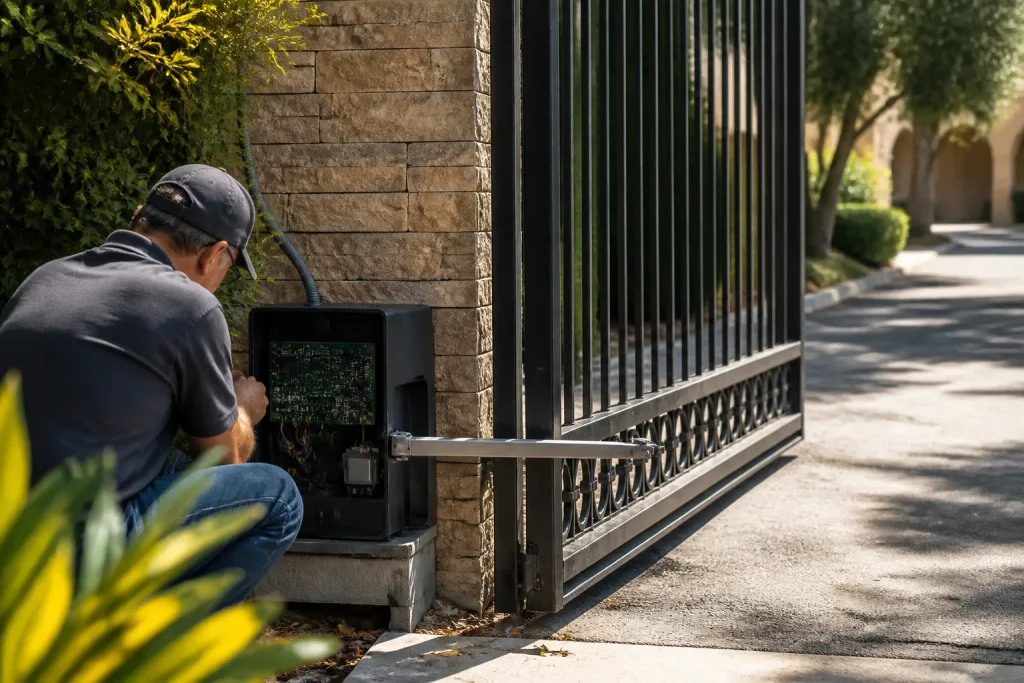
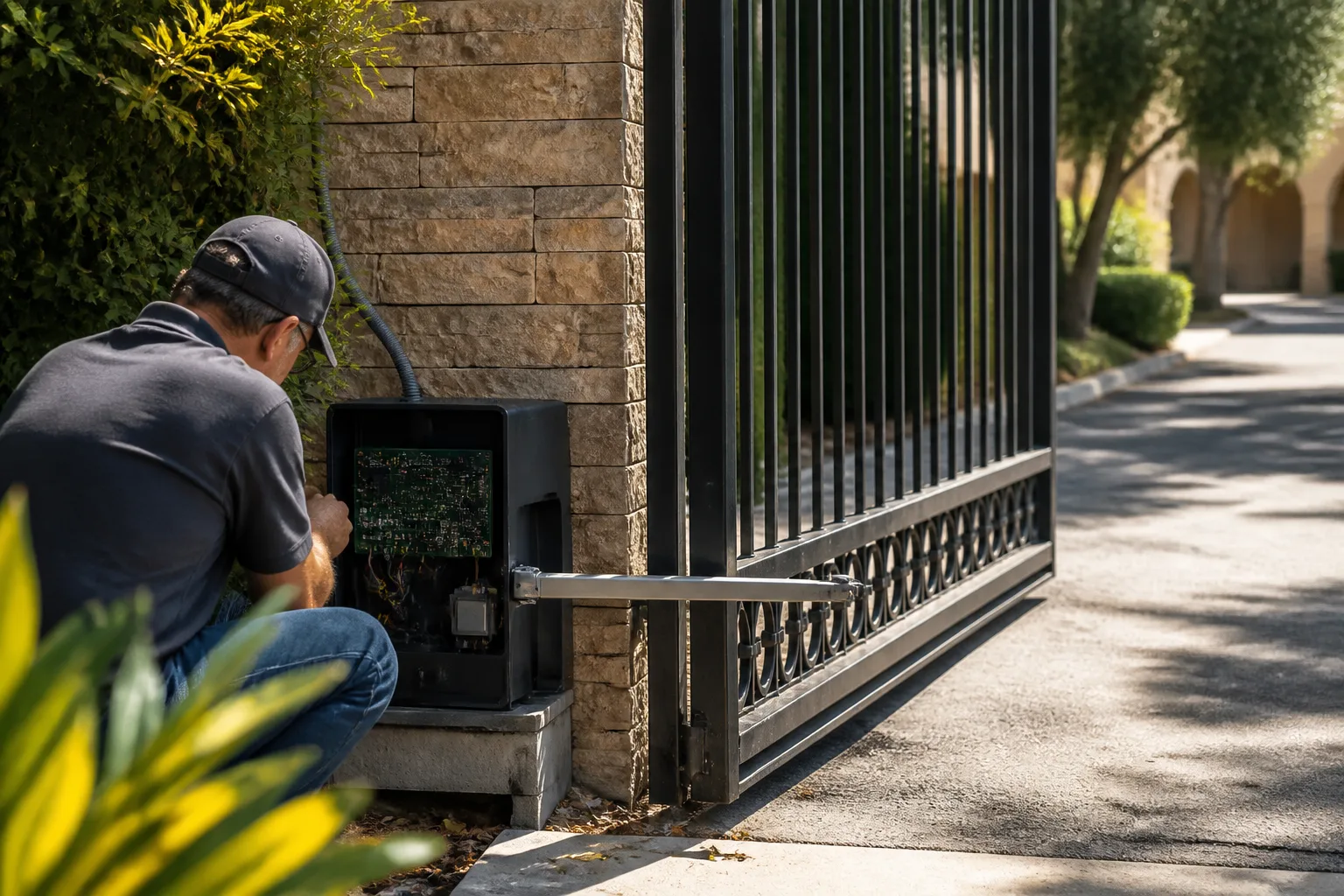
Ghost Controls Gate Repair in Northridge: A Homeowner’s Guide
Ghost Controls gate openers fail in a predictable three-stage sequence: antenna and signal trouble first, then battery and power issues, then the control board. Knowing which stage your opener is in rules out most problems before you spend a dime on service. If you’d rather skip the diagnosis and get a live person on the phone, call (925) 966-4150 and we’ll walk you through it in Northridge, free.
Ghost Controls advertises a 500-foot range, and a lot of Northridge homeowners assume that means their opener is bulletproof. It isn’t. Most service calls we run in this valley aren’t range failures at all. They’re a $4 alkaline battery baking inside a solar receiver box that hasn’t been opened since the day it was installed. The Northridge sun does that. We’ll explain precisely how below, and why the fix matters more here than in a coastal zip code.
How Ghost Controls Openers Fail: The Three-Stage Ladder
Every Ghost Controls system we service, from a basic AXDP single-swing to the dual-gate kits common on Northridge corner lots, follows the same failure pattern. Learn this sequence and you’ll know what to look at before you touch a single component.
Stage one: antenna and signal. The opener stops responding to the remote, but only sometimes. You press the button from the driveway and nothing happens. You press it again from twenty feet closer and the gate swings fine. That’s a signal problem. The receiver antenna on a Ghost Controls unit is a short wire inside the control box, and when it gets pinched, corroded, or jostled loose, the range collapses from hundreds of feet to a coin flip. The remote battery is also suspect here. We see remotes dropped into cupholders and door pockets for years, and the contacts corrode in the Northridge heat even when the battery still reads good.
Stage two: battery and power. The gate moves sluggishly, or it starts and stops mid-swing, or it beeps but won’t move at all. Ghost Controls systems are battery-fed by design, and Northridge’s heat shortens lead-acid battery life well below the manufacturer’s stated three to five years. A sealed battery in a black control box mounted on a west-facing wall in August in Northridge can cook in two summers. The solar panel helps, but only if it’s clean and angled correctly. We’ve pulled panels off in Northridge that were so dust-caked from the Santa Ana winds they were charging at maybe a third of their rated output.
Stage three: control board. The gate does nothing. No beep, no click, no movement, and the remote LED lights up but the opener ignores it completely. That’s the control board, and it’s the expensive one. Ghost Controls boards are not field-rebuildable, and a DIY board swap on a unit still under warranty can void the coverage. More on that in a minute.
Key Takeaways
- Signal trouble is intermittent and range-related. Battery trouble is slow or weak movement. Board failure is dead silence.
- Northridge heat kills Ghost Controls batteries and solar receivers faster than manufacturer estimates.
- Ghost Controls resets are owner-fixable in ten minutes. Board replacements need brand-certified labor.
- Dual-gate sync problems hide in plain sight. One arm can mask a fault in the other.
What to Check Before You Call: The 10-Minute Owner Reset
Ghost Controls units have a reset sequence that fixes more problems than you’d expect, and it costs nothing. The reset is written in every owner’s manual, but most Northridge homeowners don’t have the manual anymore. The house has changed hands or the manual went into a drawer in 2019 and hasn’t surfaced since. Here’s the procedure.
Find the control box, which is almost always mounted on the gate post or on a nearby wall. Open the cover and look for the power switch or the battery disconnect. Turn it off. Wait thirty seconds. Turn it back on. The board re-reads the limit switches and re-syncs the remote receiver. If the gate was beeping oddly or stopping mid-travel, this alone often fixes it.
If the gate still won’t move, check the battery terminals. Corrosion on a terminal in Northridge is common, especially in winter when morning fog rolls down from the Santa Susana Pass and sits on exposed metal. Clean the posts with a wire brush, reconnect, and try again. If the battery is swollen or more than three years old, it’s dead. Replace it with a sealed lead-acid battery of the same voltage and amp-hour rating printed on the old one.
If the gate still refuses to move after a reset and a battery check, you’re in stage three territory. Do not open the control board housing and start probing with a multimeter unless you’re trained for it. Ghost Controls boards carry capacitors that hold a charge, and a wiped board on a unit under warranty turns a $200 service call into a $600 replacement.
One more thing to check on the heat side: Northridge summer temperatures regularly push past 100°F. Ghost Controls specifies an operating range on their receivers, and a control box mounted in direct sun on a south-facing wall can exceed that range by twenty degrees inside the housing. If your gate only fails on hot afternoons and works fine in the morning, the receiver is thermally throttling or the battery is sagging under heat load. Shade the box, or have it relocated to a cooler mount. We’ve moved a dozen Ghost Controls receivers in Northridge off scorching stucco walls onto shaded posts and solved the problem without replacing a single part.
The Non-Obvious Dual-Gate Failure: When One Arm Hides the Other
Ghost Controls sells dual-gate kits for driveways that need two swing arms, and Northridge has plenty of those: wide lots off Corbin Avenue, corner properties on Reseda Boulevard, hillside homes up near Porter Ranch where the driveway curves. The dual-gate setup has a specific failure mode worth knowing about. The two arms sync their travel limits and motor timing through the control board, and when one arm develops a fault, the other arm sometimes covers for it.
Here’s what we mean. The symptom you see is the right gate arm closing a little slower than usual, or pausing for a half-second before it starts. The gate still opens and closes, so you ignore it. What’s actually happening is the left arm’s motor capacitor is degrading, and the control board is compensating by ramping the right arm’s speed to stay in sync. The system doesn’t throw an error code because the compensation is working, for now. Then the capacitor fails completely, and suddenly both gates stop, because the control board finally sees a fault it can’t mask. The homeowner calls us saying the right gate broke, when the right gate is fine and the left gate has been dying for six weeks.
What to watch for: any change in the rhythm of a dual gate, even a change you can’t quite name. If one arm sounds different, hesitates, or finishes its travel a beat behind the other, something is wrong. Note it, mention it on the phone, and save yourself a second visit. In our experience, the number-one cause of dual-gate Ghost Controls failures in Northridge is a neglected motor capacitor on the low side of the driveway, the arm that takes the rainwater runoff in winter and the full sun in summer.
How Northridge Heat Changes the Math on Ghost Controls Service
Ghost Controls designs its openers in the Pacific Northwest, and its published reliability numbers assume a temperate climate. Northridge isn’t temperate. Inland valley heat, Santa Ana dust storms, and winter fog off the pass all stress components in ways the manual doesn’t fully account for. We see three heat-related failures most often, and they’re worth knowing before you spend money on a service call.
First, the solar panel connector. Ghost Controls solar kits use a simple barrel connector, and that connector sits in the weather on the panel side. UV light in Northridge’s near-cloudless summers degrades the plastic, and the connector cracks. The panel produces power, but the power never reaches the battery. Homeowners tell us the solar isn’t working, and they’re right, but not for the reason they think.
Second, the remote control case. Ghost Controls remotes are plastic, and plastic left on a dash or a patio table in a Northridge August warps. The circuit board inside flexes, solder joints crack, and the remote works only when you squeeze the case at a certain angle. We pulled one out of a garage over in Northridge North last week where the homeowner had been holding the remote against his chin to extend the range, because the case had bowed just enough to break a joint and the antenna trace was cracked. A new remote fixed it. He’d been doing that for a year.
Third, the battery itself. We covered this in the failure ladder, but the heat math is worth repeating: a Ghost Controls sealed lead-acid battery rated for three years of service will last two in a Northridge summer with the box in direct sun. Buy a battery with the correct amp-hour rating, not the cheapest one on the shelf, and check it every spring before the hot months hit. A $35 battery replaced on your schedule beats a $200 emergency call in July.
What to Tell the Repair Company When You Call
When you call Ironworks Gate Co. or any repair service for Ghost Controls work in Northridge, the first three minutes of the call determine whether you’re talking to a specialist or a generalist. Have this information ready.
1. The exact model number. Ghost Controls stamps the model on a label inside the control box, usually on the left wall of the housing. Open the box, read the label, write it down. It’s something like AXDP, R30, or TSS1. Knowing the model tells us which board revision you have, and whether the unit is under warranty.
2. The three diagnostic answers. When you call, any real Ghost Controls specialist will ask you three questions. If they don’t, hang up and call someone else. The questions are: Does the remote LED light up when you press the button? Does the control box beep or click when you press the remote? Does the gate move at all, even a little? Your answers to those three questions place the fault in stage one, two, or three of the failure ladder, and a technician who knows Ghost Controls can tell you what the fix likely is before they get in the truck.
3. When the problem started. Not just the date. Was it hot that day? Had it rained? Did a Santa Ana wind event blow through? Was the gate fine the day before? Ghost Controls failures tend to be triggered by environmental stress, and knowing the trigger narrows the diagnosis fast. A gate that dies during a 103° afternoon in Northridge points to battery or receiver heat failure. A gate that dies after a rainstorm points to water intrusion on the board or a shorted connector.
When to call a pro: if the gate fails the reset procedure, if the battery is fine but the gate still won’t move, if a dual-gate arm is out of rhythm, or if you see any scorching, melting, or burnt odor from the control box. Those are board and motor faults, and they need a trained hand. We recommend gate repair in Northridge from a company that carries Ghost Controls parts, not just a generic opener board.
What a Ghost Controls Board Replacement Costs in Northridge
Board replacement is the stage-three fix, and it’s the one homeowners fear most. Here’s straight talk on price. A Ghost Controls control board for a residential swing opener typically runs between $180 and $320 for the part, depending on the model. Labor on a board swap in Northridge runs one to two hours, so you’re looking at a total in the $350 to $550 range for most single-gate residential systems. Dual-gate boards run higher because they drive two motor channels.
- Control board (part only): $180-$320
- Board swap labor: $150-$250
- Typical total for single-gate board replacement: $350-$550
- Dual-gate board replacement: $450-$700
Every Ghost Controls gate repair we quote in Northridge gets a written price before any work starts. That price is the price. We don’t quote a range and bill the top end, and we don’t add surprise line items to the invoice. If the job turns out to be simpler than we thought, you pay less. That’s the square deal, and it’s been our policy for over forty years. Related services in Northridge: gate motor and opener repair for Ghost Controls and eight other major brands, and gate installation if the opener is fine and the gate itself is the problem.
The Bottom Line
Ghost Controls openers are good machines, but they fail in a sequence, and Northridge’s heat accelerates every stage of it. Check the remote antenna and signal first, then the battery and solar panel, then the control board. If the reset procedure works, you’re done in ten minutes. If it doesn’t, call a specialist who can answer the three diagnostic questions without hesitation. Don’t chisel on a control board yourself, especially on a warranty unit. And if you have a dual gate, watch for one arm masking another’s failure. If you’re in Northridge and need help, Ironworks Gate Co. offers free estimates. Call (925) 966-4150 and a live person answers, any hour, any day.
Frequently Asked Questions
Most Ghost Controls repairs in Northridge run between $150 and $550, depending on the failure stage. A remote or antenna fix is typically $150 to $200, a battery replacement runs $75 to $150, and a control board swap is $350 to $550 for a single-gate system. Every quote is written and agreed before work starts, so the bill never surprises you. Call (925) 966-4150 for an exact quote on your model, free.
In most cases, yes. Stage-one and stage-two failures like remote issues, battery swaps, and antenna repairs are usually completed in a single visit, and we carry Ghost Controls parts on the truck. Board replacements are typically done same-day too, as long as the specific board revision for your model is in stock at our Northridge warehouse. Call and describe the symptoms, and we’ll tell you honestly whether it’s a one-visit fix.
Intermittent remote response means your opener is in stage-one failure, and the cause is almost always the remote battery, the remote’s internal antenna trace, or the receiver antenna inside the control box. Northridge heat warps remote cases and cracks solder joints over time. Try a fresh remote battery first. If that doesn’t fix it, the remote or the receiver antenna is the next suspect, and both are quick, inexpensive repairs. Call (925) 966-4150 and we’ll help you narrow it down on the phone.
We service Ghost Controls equipment in Northridge regardless of warranty status, and we perform warranty-preserving repairs on units still under the manufacturer’s coverage. Ghost Controls will not honor a warranty claim on a board that a homeowner has opened and replaced, so if you’re in stage-three on a newer unit, let a trained technician handle it. Our workmanship is protected by our own 90-Day Done Right Promise, in writing, on every job we complete.
Written by Victor Salinas, Owner at Ironworks Gate Co., serving Northridge since 2013.
Need Gate Repair Help?
Call Ironworks Gate Co. - licensed & insured, here with fast after-hours help in Northridge.
(925) 966-4150