
Quick Summary
Implementing routine driveway gate maintenance tips prevents mechanical friction, safety hazards, and unexpected breakdowns caused by daily wear and environmental exposure. The guide outlines essential preventative tasks like lubricating hinges, clearing tracks, and testing safety sensors, while recommending specialists like Ironworks Gate Co. for complex electrical and structural issues. Readers will gain a clear maintenance checklist to keep their systems operating reliably and know when to schedule a professional on-site tune-up.
Driveway Gate Maintenance Tips for Smooth, Lasting Operation
A functioning driveway gate keeps your property secure, private, and accessible. When an automated system begins sticking, squealing, or stopping halfway across the drive, the underlying issue is often mechanical friction or neglected components. Putting practical driveway gate maintenance tips into practice helps catch worn parts, alignment drift, and safety hazards before they lead to unexpected breakdowns.[4]
Routine care is also a matter of household safety. The U.S. Consumer Product Safety Commission (CPSC) highlights automatic gate operators as a key safety area involving entrapment hazards, strongly recommending strict adherence to applicable voluntary safety standards. A regular inspection routine helps ensure that safety eyes, physical stops, and reverse mechanisms respond properly when an obstacle is present.[3]
The following maintenance guide covers key mechanical and operational checks to help keep your gate running reliably, following equipment manufacturer guidance and relevant safety standards.[5]
Essential Driveway Gate Maintenance Overview and Checklist
Every gate system experiences exposure to weather, dust, and physical vibration. Environmental factors such as dust accumulation, temperature fluctuations, and ground movement can affect drive mechanisms, electrical components, and track alignment over time.
Why Preventative Care Protects Security and Accessibility
Proactive care helps reduce unexpected mechanical issues. For properties where ADA requirements apply, public accommodations must maintain accessible features and equipment in working order, with repairs made promptly when interruptions occur. For covered unattended security barriers subject to ADA standards, at least one gate must comply with applicable accessible-gate requirements, depending on the property and barrier’s legal coverage. Proper maintenance helps ensure accessible features remain operable.
Recommended Maintenance Schedule
Maintenance intervals and procedures should follow the gate and operator manufacturer’s instructions, based on equipment type, cycle volume, and site conditions. Routine visual reviews and qualified-technician service should include:
- Routine visual and operational checks: Regularly inspect gate movement, clear tracks of debris, check hardware, and verify that safety systems operate smoothly.
- Manufacturer-directed servicing: Follow the manufacturer’s recommended service intervals for hardware adjustments, linkage lubrication, and operator checks based on equipment, usage, and site conditions.
- Qualified-technician inspection: Have a qualified technician inspect electrical components, operator internals, mechanical limits, and structural posts whenever wear, damage, or unsafe operation is detected.
Choosing the Right Gate Lubricants
Always use the lubricant specified by the gate and operator manufacturer for each hinge, chain, track, or drive mechanism. Applying incorrect lubricants can attract debris or fail to protect moving components.
| Lubricant Type | Where to Apply | Key Benefits and Notes |
|---|---|---|
| Manufacturer-Specified Dry Lubricant | Exposed components where recommended by the manufacturer | Helps reduce friction without attracting dust and grit when specified by equipment manuals |
| Manufacturer-Specified Grease | Designated grease fittings or enclosed gearboxes as specified | Use only where specifically directed by the gate or operator manufacturer |
| Standard Solvent Sprays (e.g., WD-40 Multi-Use) | Surface cleaning and degreasing only if approved | Typically not a long-term lubricant; follow manufacturer guidance |
Lubricant Selection by Mechanism
Always consult the gate and operator manufacturer’s instructions for the specific lubricant required for each hinge, chain, track, or drive mechanism. Different mechanisms require specific formulations to function properly without causing premature wear or attracting debris.
Visual Checks vs. Professional Operator Diagnostics
As noted by specialists at Ironworks Gate Co., property owners and facility managers can handle basic visual reviews and routine track cleaning. However, internal electrical troubleshooting, operator adjustments, and structural repairs require professional tools and training. When wear, damage, or unsafe operation is found, contact a qualified technician.
1. Lubricate Heavy-Duty Gate Hinges and Rollers
Hinges on swing gates and guide rollers on sliding gates support substantial moving weight. Without proper lubrication, pivot points can bind and place additional strain on the operating system.
Proper Lubrication Steps
To care for your hinges and guide assemblies correctly:
- Wipe away old lubricant, accumulated dirt, and grime from hinge seams and roller brackets with a rag.
- Apply only the lubricant specified by the gate and hardware manufacturer for pivot points, sleeve bearings, and roller pins.
- If hinges or bearings feature grease fittings, use the specific grease type recommended by the manufacturer.
- Cycle the gate to distribute the lubricant evenly across moving surfaces as directed by the manual.
2. Inspect Operator Housing and Electrical Components
Need driveway gate maintenance tips?
We’re available now - call for a fast, free estimate.
Electric gate operators house sensitive control boards, transformers, and electrical components. External environmental conditions, pests, and wear can impact electronic circuits over time.
Qualified-Technician Operator Inspections
Internal operator cabinet inspections and electrical diagnostic procedures should only be performed by a qualified technician. Technicians typically inspect:
- The interior cabinet for insect nests, debris, or pest activity that may compromise internal wiring.
- Capacitors, transformers, and circuit boards for signs of wear, physical damage, or overheating.
- Electrical terminals, wiring connections, and moisture seals around cable entry ports.
- Overall electrical safety, grounding, and system control integrity according to manufacturer standards.
3. Clear Sliding Gate Tracks and Verify Physical Positive Stops
Sliding gates depend on a clean ground track and solid mechanical stops at both ends of travel. When soil, gravel, or debris fills the track groove, the gate wheels can bind or derail.
Cleaning Ground Tracks
Scrape compacted dirt and small rocks out of the track profile using a stiff brush or appropriate cleaning tools. Inspect the bottom wheels for flat spots, grooving, or bearing play.
Checking End-Stop Integrity
Positive stops are heavy steel brackets welded or bolted at the full open and full closed positions. California occupational-safety data identify failed or missing gate end-stops or positive-stops as a recurring factor in serious gate incidents, supporting regular inspection of travel limits and stopping components. Inspect these physical stops routinely according to manufacturer guidance to ensure mounting bolts are tight, weld seams show no fractures, and rubber catch bumpers remain intact. If damage is found, have a qualified technician repair or replace components.[1]
4. Realign and Clean Photo-Eye Safety Sensors
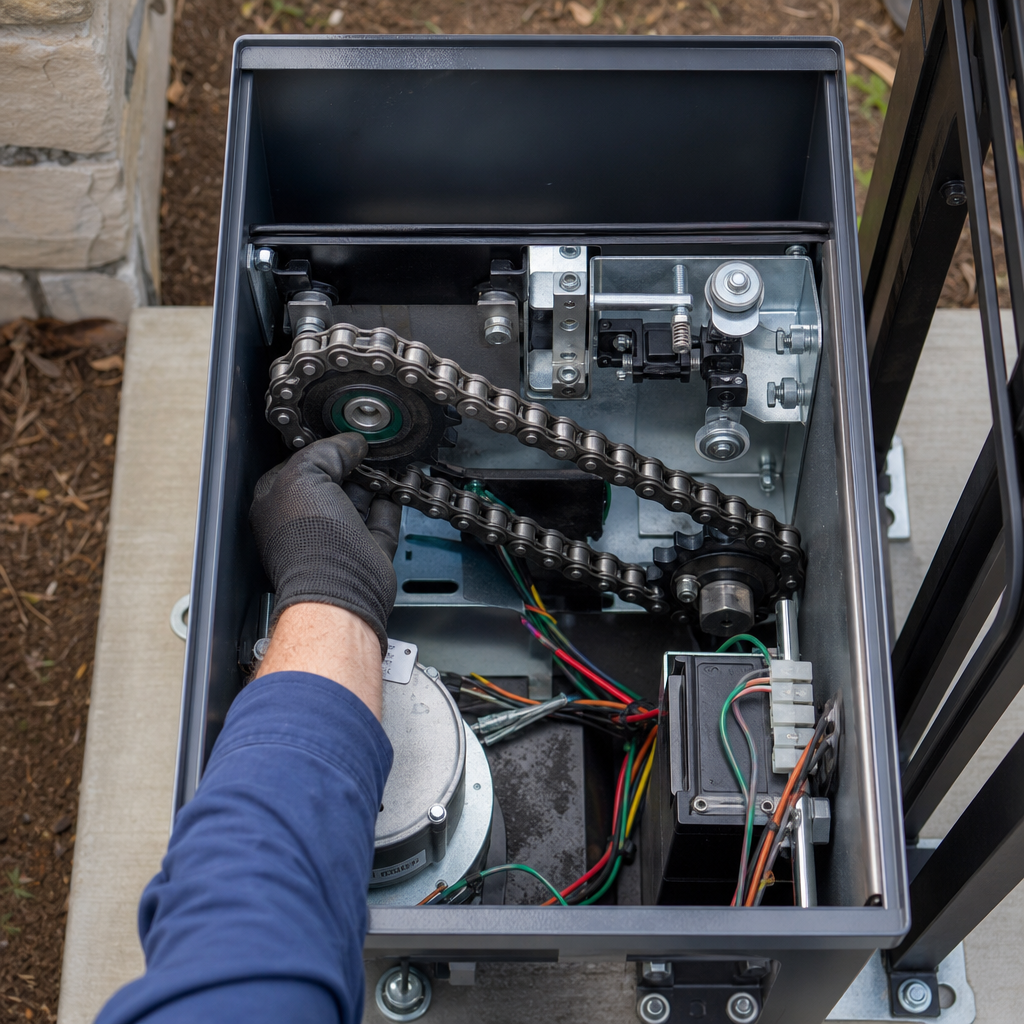
Photo-eye sensors project a beam across the driveway opening. If an obstacle interrupts this path while the gate is closing, the operator is designed to stop and reverse direction according to safety standards.
Cleaning and Alignment
Dust, dirt, and spiderwebs can coat sensor lenses, affecting operation. Clean lenses using methods recommended by the manufacturer. Verify that mounting brackets remain aligned and that sensor indicators confirm a proper signal according to equipment instructions.
Entrapment and Safety Device Testing
All entrapment and obstruction-sensing devices should be tested according to the manufacturer’s instructions. If any sensor or reverse mechanism fails to function properly, or if unsafe operation is observed, the gate system must immediately be removed from service and repaired by a qualified technician before being returned to use.[2]
5. Check Drive Chains, Belts, and Travel Limit Switches
Over time, mechanical drive chains and belts can experience wear and loosen. Excess slack can lead to irregular movement or travel limit issues.
Tensioning Drive Linkages
Inspect drive linkages and chain tension in accordance with the operator manufacturer’s manual, which provides the specific tension and sag tolerances for the equipment. If adjustment is required, follow the manufacturer’s procedure. Apply only the chain lubricant specified by the manufacturer to protect links from wear.
Correcting Limit Switch Drift
Limit switches signal the operator when to stop at each end of travel. Check travel limits according to manufacturer instructions if the gate’s stopping positions change, or consult a qualified technician to make precision limit adjustments.
6. Treat Surface Rust on Wrought Iron Gate Frames
Need driveway gate maintenance tips?
We’re available now - call for a fast, free estimate.
Wrought iron and tubular steel gates require ongoing surface care. Moisture around weld joints and ground contact areas can lead to oxidation if left unaddressed.
General Suggestions for Surface Rust Maintenance
The following are general maintenance suggestions requiring product and equipment manufacturer guidance rather than research-verified procedures:
- Surface preparation: Remove loose paint flakes and surface rust down to clean metal using appropriate wire brushes or abrasive pads as recommended by paint and coating manufacturers.
- Rust-inhibiting primer: Apply a suitable metal primer formulated for exterior iron or steel surfaces according to the coating manufacturer’s instructions.
- Protective topcoat: Finish with an exterior-grade paint designed for outdoor metalwork to protect the surface.
If corrosion affects structural integrity, hinge plates, or load-bearing posts, have a qualified technician or professional fabricator such as Ironworks Gate Co. inspect and repair the gate.
7. Test Manual Release Mechanisms and Safety Loops
Power outages or system faults can leave automated gates unresponsive. You must be able to disengage the drive mechanism to open the gate manually when needed.
Testing the Emergency Release
Locate the operator release key or mechanical disconnect mechanism according to the manual. Disengage the drive mechanism and manually test the gate movement. The gate should move smoothly along its path. If moving the gate by hand reveals binding or unusual resistance, inspect the hardware or contact a qualified technician.
Verifying Vehicle Detection Loops
Test vehicle detection loops and obstruction-sensing devices according to the manufacturer’s instructions to ensure the gate holds open or responds properly when vehicles are present. If detection systems fail, remove the automated gate from service and contact a qualified technician.
8. When to Call a Professional for Gate Repairs
While routine visual checks and external cleaning can be performed regularly, mechanical, electrical, and structural issues require a qualified technician.
Contact a qualified technician immediately if you encounter:
- Grinding, squealing, or unusual noises from internal gearboxes or drive motors.
- Electrical component issues, damaged wiring, or tripped breakers.
- Gates that sag, drag along the ground, or bind due to post or hinge damage.
- Any failure of safety sensors, entrapment protection, or travel limit stops.
Frequently Asked Questions About Driveway Gate Maintenance
How often should an automatic driveway gate be serviced?
Service intervals should follow the gate and operator manufacturer’s instructions based on the specific equipment, daily usage, and site conditions. Property owners should conduct routine visual and safety checks, and schedule service with a qualified technician whenever wear, damage, or irregular operation is identified.
What is the best lubricant to use on gate hinges and chains?
Always use the lubricant specified by the gate and operator manufacturer for each hinge, chain, track, or drive mechanism. Different equipment and components require specific manufacturer-approved lubricants to ensure proper operation and prevent premature wear.
How do I prevent rust and corrosion on wrought iron gates?
As a general maintenance suggestion, regularly inspect weld seams and metal surfaces for signs of corrosion. When surface rust appears, follow product manufacturer guidance for surface preparation, rust-inhibiting primer, and exterior protective topcoats, or consult a qualified specialist like Ironworks Gate Co. for structural metal repairs.
What routine maintenance does an electric gate opener require?
Routine maintenance should follow the operator manufacturer’s instructions. Routine checks include testing all entrapment and obstruction-sensing devices, keeping external tracks and enclosures clear of debris, and monitoring drive chain or belt operation. Internal operator housing inspections, electrical checks, and repairs should be performed by a qualified technician.
Why is my sliding driveway gate sticking or moving slowly?
Sliding gates usually stick because of debris packed inside the ground track, worn or seized wheel bearings, loose drive chains, or guide rollers binding against the top frame. Clear the track groove thoroughly, inspect wheel bearings for play, and ensure the gate rolls freely when disconnected from the operator.
When should I call a professional for driveway gate repairs?
Call a qualified gate technician whenever you find internal operator or electrical faults, failed safety or entrapment devices, worn or damaged structural posts and hinges, or any condition where the gate operates unsafely.
Need driveway gate maintenance tips?
We’re available now - call for a fast, free estimate.
Sources
- 2024-11-20-COPF-CODD-Hummingbird-Alliance-Meeting- … – cpsc.gov (2024)
- Petition File No. 605 Cal/OSHA Evaluation – dir.ca.gov (2024)
- UNITED STATES CONSUMER PRODUCT SAFETY COMMISSION WASHINGTON … – cpsc.gov (2003)
- [PDF] Illinois High-Speed Rail Four-Quadrant Gate Reliability Assessment … – railroads.dot.gov (2009)
- Garage Door Operators/Gate Operators – cpsc.gov (2006)
Related reading: How Do Gate Loop Detectors Work | Call Now-10% Off | Same-Day Service | Free Estimate
Related reading: Residential Vs Commercial Gate Operators – Call Now-10% Off – Same-Day Service – Free Estimate
Related reading: Automatic Gate Troubleshooting | Call Now-10% Off | Same-Day Service | Free Estimate
Frequently Asked Questions
Why does my automatic driveway gate reverse on its own when nothing is blocking it?
Phantom reversals are typically caused by dirty or misaligned photo-eye lenses, ground loop sensitivity drift, or mechanical resistance triggering the operator's internal safety stop. Property owners should clean sensor lenses and clear track debris to see if the issue resolves. If false reversals persist, contact the team at Ironworks Gate Co. to inspect electrical components and recalibrate travel limit switches.
What is included in a professional driveway gate preventative maintenance tune-up?
A comprehensive professional tune-up includes internal operator cabinet diagnostics, electrical wiring and transformer inspections, safety sensor realignments, and mechanical chain or belt tensioning. Technicians also lubricate critical bearings using manufacturer-approved greases and check structural posts for signs of sag or weld fatigue. Property owners can schedule a same-day preventative maintenance tune-up with Ironworks Gate Co. to extend system longevity.
How do I safely operate my electric driveway gate during a power outage?
Use the operator's manual release key or mechanical disconnect lever to decouple the drive motor, allowing you to push the gate open by hand. Always verify that sliding tracks or swing paths remain clear of obstacles before manually guiding the gate. If the emergency release binds or the gate feels excessively heavy to move, have Ironworks Gate Co. inspect your hinges and hardware alignment.
About the author
 |
David Caldwell David is a technical writer specializing in home services and automated access systems. With over a decade of experience covering residential and commercial property maintenance, he translates complex gate repair concepts and pricing structures into clear, actionable advice. He holds a B.A. in Communications from California State University, Northridge. |
Gate not opening, off track, or opener dead?
We’re available now - call for a fast, free estimate.
Call Now - Free Estimate