
Quick Summary
When automated driveway gates stall or derail, mechanical drag from obstructed tracks, failing rollers, or misaligned sensors is frequently mistaken for total motor failure. As an honest repair specialist, Ironworks Gate Co. diagnoses and services salvageable hardware – such as seized roller bearings, stretched drive chains, and optical safety eyes – to prevent costly and unnecessary operator replacements. Property owners will learn the essential steps to troubleshoot common mechanical faults and can contact Ironworks Gate Co. for reliable same-day sliding gate repair or a free on-site safety inspection.
Sliding Gate Repair: Troubleshooting Stuck Driveway Gates
When an automated sliding gate stops halfway across a driveway or refuses to budge, property owners often assume the motor has burned out. In many instances, what appears to be a motor failure may instead be an operator shutting down or struggling due to physical drag, track obstructions, worn rollers, or misaligned components.[5]
A derailed or jammed gate is also a serious safety risk. ASTM reported that California’s occupational safety agency released a 2024 evaluation of horizontal sliding gates that included accident history, documenting 47 severe workplace accidents between 1990 and 2024 involving gates jumping their tracks and falling. Gate Safe also reported that over 90% of the more than 100 automated gates reviewed in their survey were deemed unsafe, with just under 80% of the 49 sliding gates evaluated failing basic safety benchmarks. Systematic troubleshooting, as recommended by specialists at Ironworks Gate Co., helps pinpoint the mechanical or electrical cause, helping avoid unneeded operator replacements.[1]
Step 1: Disengage the Clutch and Isolate Mechanical Drag
General troubleshooting procedures suggest checking mechanical movement before inspecting electrical components. Always follow manufacturer instructions and safety precautions when servicing equipment.
- Disconnect power: Turn off power at the dedicated breaker feeding the gate operator before performing mechanical checks.
- Disengage the manual release: Use the manufacturer key or release mechanism to disconnect the drive mechanism according to user manual instructions.
- Test the gate travel manually: Check gate leaf travel along its path from fully open to fully closed where safe to do so.
A properly installed gate should generally move smoothly along its path. If significant physical effort is required to move the gate manually, excessive mechanical resistance may be preventing normal automated operation or causing strain on the drive system.
Step 2: Inspect Tracks and Roller Bearings
Ground tracks and bottom rollers carry the weight of a sliding gate. Environmental conditions or soil movement can cause alignment issues or obstructions along the track.
| Track Style | Common Failure Points | General Maintenance and Repair Scope |
|---|---|---|
| Inverted V-Track | Bowing, debris accumulation, loose anchor bolts | Clearing track path; realigning track sections; securing loose anchors |
| Round Pipe Track | Track wear, shifting support surfaces | Adjusting track supports; servicing guide brackets |
| Cantilever Internal Track | Debris inside trolley track, worn roller bearings | Clearing internal track channels; servicing trolley assemblies |
Inspecting and Servicing Rollers
According to Ironworks Gate Co. technicians, when roller bearings wear or seize, wheels can drag rather than turn smoothly. Typical inspection and maintenance considerations include:
- Securing the gate panel with appropriate supports so it cannot fall or tip during inspection. Note that general automatic gate injury data compiled by the CPSC shows that thousands of injuries occur around automated gates, making structural stabilization essential before unbolting any hardware.
- Inspecting wheel assemblies and mounting hardware for wear or damage.
- Replacing worn rollers with appropriately rated replacement assemblies per manufacturer specifications.
- Checking guide rollers to ensure the gate remains properly aligned and plumb.
Step 3: Check Drive Chain Tension and Alignment
For chain-driven operators, improper tension or alignment can affect performance:
- Chain Tension: Operators generally require moderate tension without excessive tightness or extreme slack, following manufacturer specifications.
- Chain Alignment: As Ironworks Gate Co. advises, the chain should travel inline with drive sprockets to prevent uneven wear.
- Lubrication: Manufacturers typically recommend lubricants that do not attract heavy dirt and grit buildup.
Step 4: Inspect Safety Photo-Eyes and Detection Devices
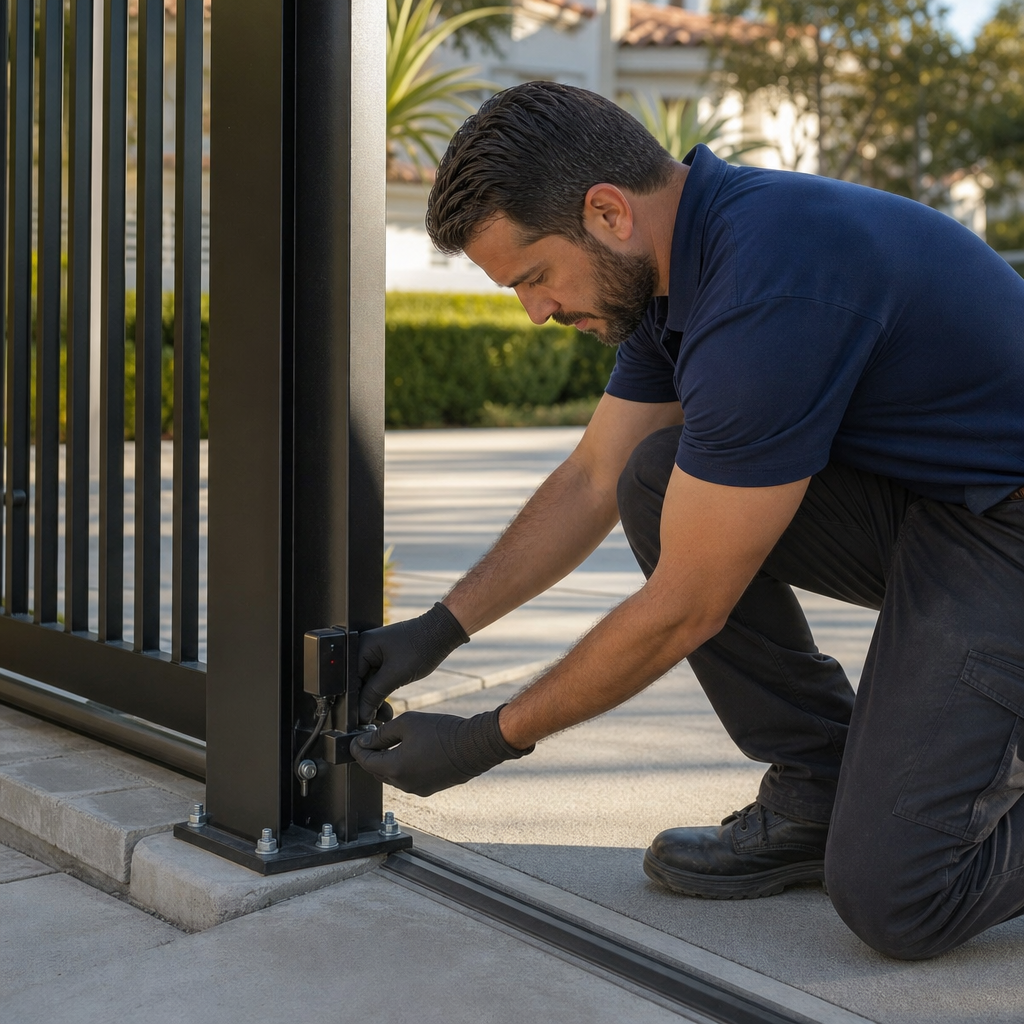
When an automated gate opens but fails to close properly, safety devices are a common area to evaluate:
- Inspect Optical Lenses: Check sensors for dirt, cobwebs, moisture condensation, or physical obstructions.
- Verify Sensor Alignment: Consult manufacturer diagnostic indicator lights to verify proper beam alignment between sending and receiving units.
- Inspect Detection Loops: Check loop detector status indicators in the control cabinet according to manufacturer diagnostic guidelines.
Step 5: Check Travel Limits and Logic Controls
Limit devices indicate when the gate has reached fully open or closed positions:
- Limit Switches: Verify mechanical or magnetic limit switches trigger at the intended stopping points according to product manuals.
- Magnetic Sensors: Clean and verify the position of magnetic sensors along the rack or chain.
- Control Board Diagnostics: Inspect the control board for visible fault codes, blown fuses, or tripped safety inputs before determining whether component service is necessary.
Evaluating Sliding Gate Repair vs. Replacement Costs
According to Ironworks Gate Co., repairing an existing sliding gate operator is often practical when the gate frame and core structure remain sound. Common sliding gate repairs generally range from about $150 to $1,200, with standard repairs typically falling between $200 and $650.[2]
| Service / Component Scope | Cost Category | General Recommendation |
|---|---|---|
| Bottom Roller Servicing or Replacement | Common repair ($150 – $1,200 range) | Service or replace when bearings freeze, squeak, or show severe wear. |
| Safety Photo-Eye Realignment or Replacement | Standard repair ($200 – $650 range) | Realign or replace when optical devices fail or become damaged. |
| Control Board or Component Service | Standard to major repair ($150 – $1,200 range) | Evaluate when logic circuits or relays fail diagnostic tests. |
| Ground Track Realignment or Repair | Common repair ($150 – $1,200 range) | Level and secure misaligned tracks to restore smooth travel. |
| Full Operator Replacement | Comprehensive replacement scope | Consider when internal mechanical assemblies sustain irreparable damage. |
Frequently Asked Questions About Sliding Gate Repair
How much does it cost to repair a sliding gate?
Common sliding gate repairs generally range from about $150 to $1,200, with many standard repairs falling between $200 and $650 depending on the nature of the issue. Routine adjustments or sensor realignments typically represent lower-cost repairs, while extensive component replacements fall toward the upper end of the range.[4]
Why is my automatic sliding gate not opening or closing?
Common causes include obstructed or misaligned safety photo-eyes, loss of power, a disengaged manual release, track obstructions, or tripped control circuits. Checking power sources and safety devices is typically the first diagnostic step.
Can I replace a sliding gate motor myself or do I need a professional?
While basic maintenance like clearing track debris and cleaning sensor lenses can often be performed by property owners, electrical troubleshooting and major mechanical repairs carry risks. Automated gates involve high-voltage connections and heavy moving panels that can cause injury if not properly secured.[3]
How do you fix a sliding gate that jumped off its track?
Turn off electrical power and secure the gate panel upright with appropriate supports to prevent falling. Inspect the track for debris or distortion, check rollers for damage, and ensure guide assemblies hold the gate plumb before testing movement manually.
What are common causes of sliding gate chain or sensor failure?
Chain issues often stem from improper tension, misalignment, or dirt accumulation. Safety sensors commonly malfunction due to dirty lenses, physical misalignment, moisture ingress, or wiring faults.
How often should an electric sliding driveway gate be serviced?
Routine maintenance intervals depend on usage and site conditions. According to Ironworks Gate Co., typical service includes checking track alignment, testing safety devices, inspecting roller and chain condition, and verifying proper limit adjustments.
Sources
- [PDF] Petition File No. 605 Cal/OSHA Evaluation – dir.ca.gov (2024)
- Injury patterns and epidemiology of automatic door-related … – pubmed.ncbi.nlm.nih.gov (2024)
- New Safety Standard for Automatic Security Gates Helps … – cpsc.gov (2001)
- AB 2149 (Connolly) – sjud.senate.ca.gov (2001)
- Evaluating Sources Guide : Criteria for Evaluating Sources – guides.libraries.psu.edu
Related reading: Slide Gate Repair – Call Now-10% Off – On-Site in 60 Minutes – Free Estimate
Related reading: Gate Post Repair | Call Now-10% Off | On-Site in 60 Minutes | Free Estimate
Related reading: Sagging Gate Repair | Call Now-10% Off | On-Site in 60 Minutes | Free Estimate
Frequently Asked Questions
How do I know if my sliding gate issue is a mechanical failure or a dead motor?
Disengaging the manual release clutch allows you to test if the gate moves freely along the track by hand. If you encounter heavy resistance or grinding, seized roller bearings or track warping are usually triggering the motor's safety overload shutoff. Ironworks Gate Co. specializes in isolating these mechanical drag issues to restore salvageable hardware without selling you an unneeded replacement motor.
Why does my automatic sliding gate stop moving a few inches before closing?
Premature stopping is commonly caused by limit switch drift, stretched drive chains skipping teeth, or vibrating safety photo-eyes losing beam alignment near the end of travel. On heavy-duty operators like the LiftMaster SL3000, routine wear can knock mechanical limit nuts out of calibration. Ironworks Gate Co. offers same-day sliding gate repair to realign sensors and reset limit switches to factory specifications.
Can damaged tracks and worn gate rollers be repaired without replacing the entire operator?
Yes, ground V-tracks can often be leveled, cleared, and re-anchored, while worn bottom rollers can be individually replaced with heavy-duty sealed bearing assemblies. As an independent specialist, Ironworks Gate Co. focuses on rebuilding track and wheel hardware rather than pushing costly full-system replacements. Property owners can schedule a free on-site safety and track inspection to evaluate salvageable components.
About the author
 |
David Caldwell David is a technical writer specializing in home services and automated access systems. With over a decade of experience covering residential and commercial property maintenance, he translates complex gate repair concepts and pricing structures into clear, actionable advice. He holds a B.A. in Communications from California State University, Northridge. |
Gate not opening, off track, or opener dead?
We’re available now - call for a fast, free estimate.
Call Now - Free Estimate