
Last updated August 25, 2026
Free on-site gate assessment - hinges, posts, and your LiftMaster or Nice gate operator checked before anything is quoted
The assessment is free and the quote is the invoice.
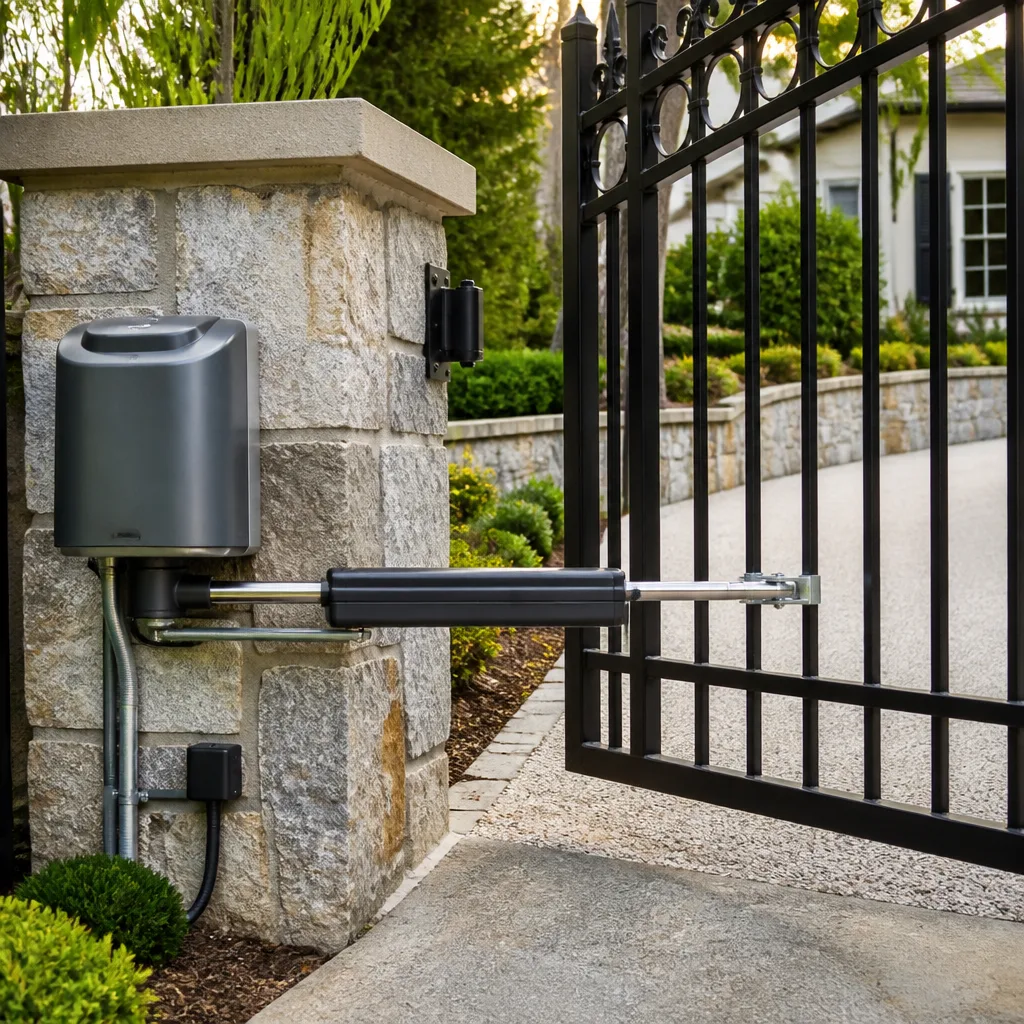
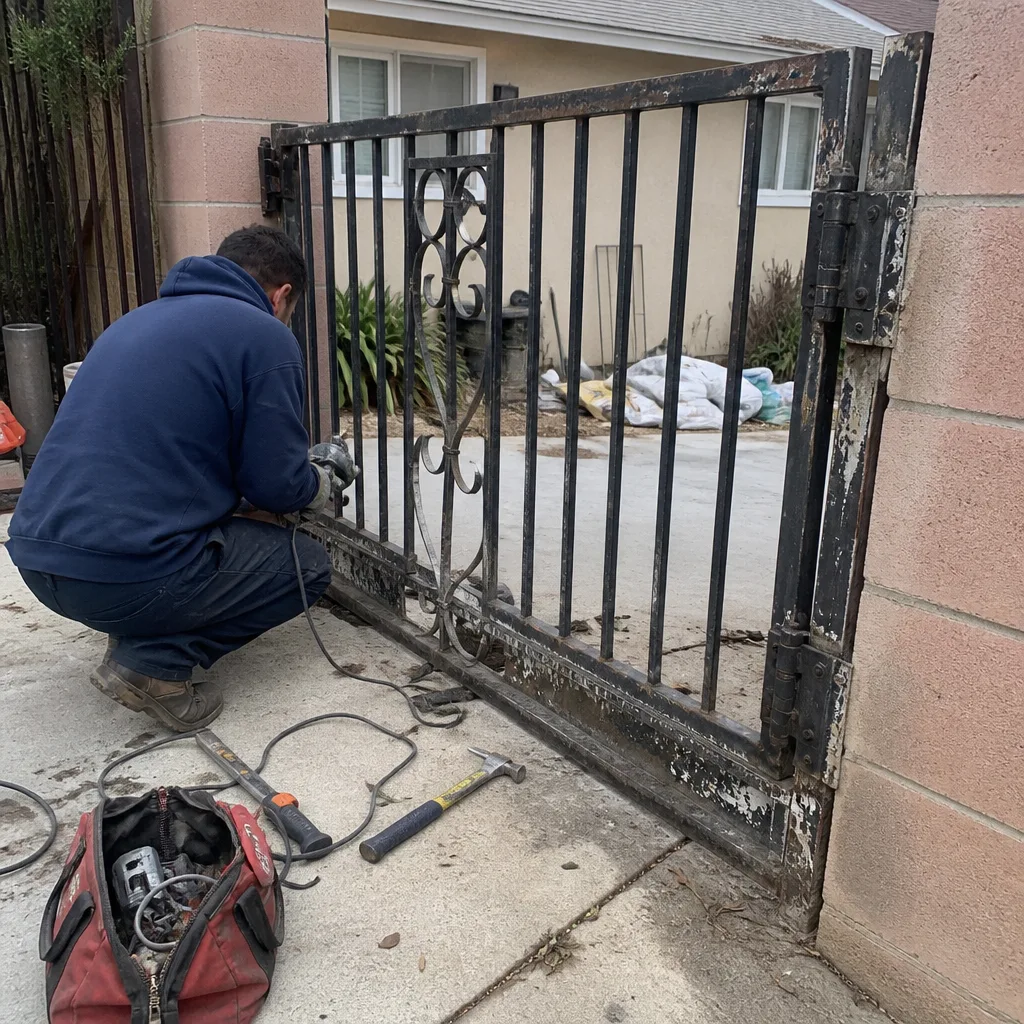 Before
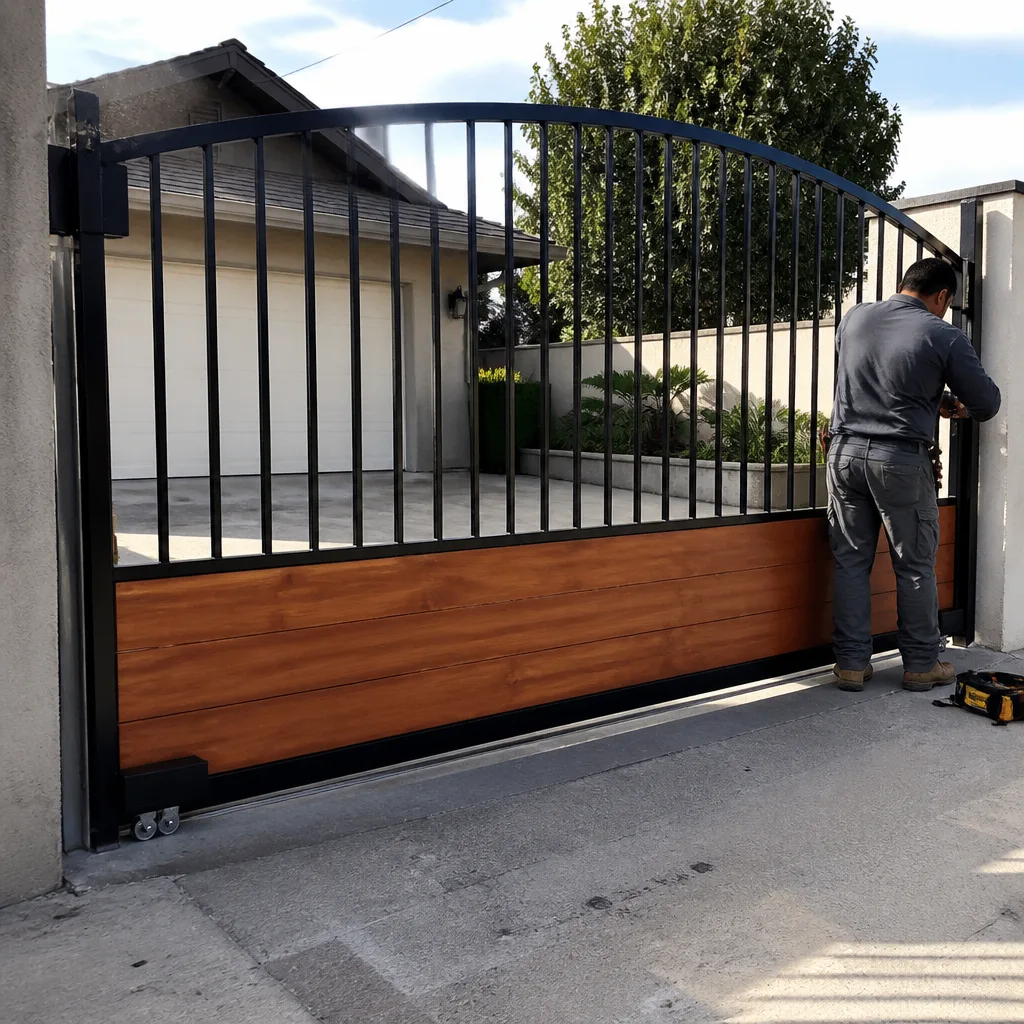 After
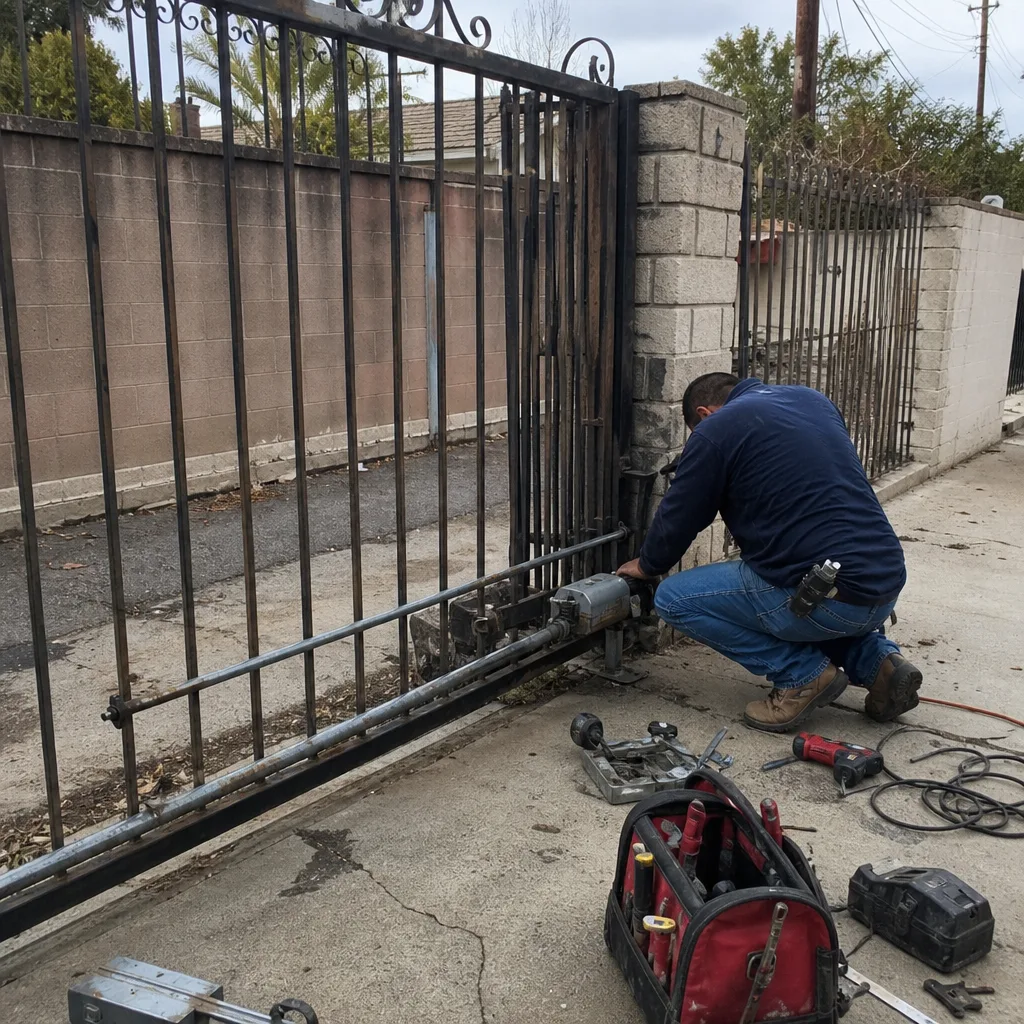 Before
 After
 Before
 After
DIY vs Professional Gate Repair: The Northridge Homeowner’s Decision Guide
Over 70% of Northridge homes built before 1990 still have their original driveway gate hardware. That means the hinges, the wheel tracks, the post mounts: all of it has spent more than three decades in San Fernando Valley heat, and a surprising amount of it is still working. The question is never whether a gate will eventually need repair. It is whether the repair gets done once, or gets done twice. This guide lays out exactly what a Northridge homeowner can safely handle themselves, what should be left to someone with a welder and a multimeter, and how to tell the difference before you are halfway through a Saturday afternoon with a gate lying on its side. We will cover costs, common failure points, the tools you would actually need, and the mistakes that turn a $200 hinge job into a $2,000 track replacement. By the end, you will know precisely when to pick up the wrench and when to pick up the phone.
Quick Answer
Most Northridge homeowners can handle surface-level gate maintenance: cleaning the track, tightening visible bolts, painting surface rust, and lubricating hinges. But anything involving a gate’s structural weld, a torsion spring under load, an electrical motor, a capacitor, or a gearbox should be handled by a trained professional, both for safety and because the cost of a failed DIY attempt on those systems almost always exceeds the cost of doing it right the first time. When the gate stops moving, most of the jobs we are called out to fix are repairs that started as a weekend project.
Table of Contents
- What You Can Safely Handle Yourself
- What You Should Never Attempt as a DIY Repair
- Understanding What Is Actually On Your Driveway
- DIY Cost vs Professional Repair Cost in Northridge
- The Hidden Costs of a Failed DIY Gate Repair
- Common Mistakes to Avoid
- When to Call a Professional
- Frequently Asked Questions
What You Can Safely Handle Yourself
A steel or wrought-iron gate is a big, heavy piece of metal that moves. The parts that wear out first are nearly always visible, accessible, and bolted on rather than welded. Those are the projects a careful homeowner in Northridge can take on without calling us, and doing them well will genuinely extend the life of the gate. Here is what falls into that category.
Cleaning and Adjusting the Track
Sliding gates in Northridge collect a lot of debris. The same Santa Ana winds that rattle the palm trees push sand, leaves, and small gravel into the V-track channel, and a gate that fights through that grit every day will eventually bind or jump the rail. If your sliding gate has become noisy or jerky, start by clearing the track. A stiff brush, a shop vacuum, and a garden hose will remove ninety percent of what is in there. Once the track is clean, check that the guide rollers are still sitting centered in the channel. If the gate leans slightly, the rollers may have shifted, and the mounting bolts can usually be adjusted with a standard socket set. This is routine maintenance, not repair, and it takes under an hour.
Lubricating Hinges and Rollers
Metal on metal will always complain. A gate that squeals when it opens is usually a gate that has not seen lubricant in years. Use a dry lubricant with PTFE or a white lithium grease on hinge pins and roller bearings. Do not use WD-40 as a repair tool: it displaces moisture and works as a cleaner, but it is too light to serve as a lasting lubricant. A proper lube job takes fifteen minutes and will quiet most hinge noise immediately.
Tightening Fasteners
Every gate in Northridge sits on concrete that moves. The soil here is expansive in places, and over years of heat-cool cycles the concrete slab shifts by fractions of an inch at a time. That is enough to loosen the bolts that hold the gate to its post or the operator bracket to the gate. Walk your gate line with a socket set and snug up anything that wiggles. Pay special attention to the bolts at the hinge connection and the bolts that mount the opener arm. A gate that rattles when it closes is almost always a gate with loose bolts.
Surface Rust Treatment
Northridge is dry, so serious rust-through is less common here than in coastal communities. But surface rust still appears where the paint has chipped, especially near the bottom rail where irrigation overspray hits the metal. If you catch surface rust early, you can stop it with a wire brush, a rust-converting primer, and a coat of exterior enamel. This is cosmetic work, and it will keep the gate looking clean for years. If the rust has eaten through the metal or compromised a weld point, that is no longer a paint project, and it needs professional attention.
What You Should Never Attempt as a DIY Repair
Now we get to the part of the conversation that matters most. There are systems on a driveway gate in Northridge that can seriously injure a person, and there are systems that are too expensive to learn on. We are not being cautious for the sake of it. We have been called out to homes where a homeowner had already spent a full weekend and several hundred dollars making a problem worse. Here is what to leave alone.
Anything Under Spring Tension
A torsion spring on a gate carries the same kind of stored energy as a garage door spring. That energy has to go somewhere, and if it releases while you are adjusting it, it will go through whatever is in its path. Do not attempt to adjust, rewind, or replace a gate torsion spring yourself. The same applies to tension rods and cable systems. A trained professional has the winding bars, the safety procedures, and the experience to do this without putting a hole in a car or a person. This is not a “watch a YouTube video and figure it out” situation.
Motor and Capacitor Work
A gate opener motor in Northridge is a sealed electromechanical unit. When it fails, it fails for a reason: a burned capacitor, a stripped gear, a failed limit switch, or a control board that has given up. Diagnosing which of those four things is the actual problem requires testing with a multimeter and, more importantly, knowing what the readings should be. Opening a motor housing and poking around with a screwdriver will not reveal much, and it may void whatever warranty remains on the unit. We service nine gate-automation brands, and the number of repair calls we get that begin with “well, I opened it up and now…” is not small.
Welding and Structural Repair
If your gate post is cracked, your hinge plate has torn loose, or a weld has failed on the frame, the solution is a welder. Not epoxy. Not a hardware-store bracket kit. Not hose clamps. The gate on a Northridge driveway is a structural element: it swings through an arc on a pivot point, and a bad weld on a hinge mount will fatigue and fail, usually when someone is standing too close. Welding is a skill that takes years to develop, and the equipment is not the kind of thing you buy at a box store and master on a Saturday. A proper field welder can repair a cracked post cap or re-weld a hinge plate in under an hour, and the repair will outlast the gate.
Control Board and Access Control Wiring
Modern gate openers talk to keypads, intercoms, loop detectors, and sometimes smartphone apps. The wiring for these systems runs through conduit under the driveway, and a short circuit in the wrong place can damage the control board, the keypad, and the motor at the same time. If your gate works from one keypad but not another, or works sometimes and not other times, do not start cutting wire. This is a diagnostic job, and the diagnosis matters more than the fix.
Understanding What Is Actually On Your Driveway
Before you decide whether to tackle a repair yourself, it helps to know what you are looking at. Most Northridge homes have one of two gate types: a sliding gate on a track or a swing gate on hinges. Each has its own failure profile, and the repairs are not interchangeable. We have walked up to gates that homeowners described as “broken” when the real problem was a $15 pair of hinges, and we have walked up to gates described as “sticking” when the real problem was a failing gearbox on a fifteen-year-old operator. Knowing what you have is step one.
A sliding gate moves horizontally along a steel track, carried by rollers and guided by a drive chain or belt connected to an opener. The most common failure points are the track itself, the rollers, the chain tension, and the limit switches inside the operator. A swing gate pivots on hinges mounted to a post, with one or two opener arms that push and pull it through an arc. Swing gates fail at the hinges, the opener arm, and the post base. In Northridge, swing gates also face a specific issue: the heat. Expansion and contraction of the metal through summer and winter cycles will slowly work hinge bolts loose and cause the gate to sag. We see more sagging swing gates in the San Fernando Valley than anywhere else we work, and the fix is usually hinge adjustment rather than gate replacement.
DIY Cost vs Professional Repair Cost in Northridge
The honest math on gate repair is this: for simple maintenance, DIY is cheaper. For anything beyond tightening and lubricating, the numbers usually flip. Here is a realistic breakdown of what Northridge homeowners can expect to spend on common repairs, both doing it themselves and calling a professional.
Typical Gate Repair Costs in Northridge
- Hinge replacement (swing gate): DIY parts $25-$80 per hinge. Professional service $150-$350 including parts and labor.
- Track realignment or roller replacement (sliding gate): DIY parts $40-$120. Professional service $180-$400.
- Opener motor replacement: DIY parts $250-$600, but requires electrical work and programming. Professional replacement $700-$1,400 installed and configured.
- Control board replacement: DIY part $120-$300, but board and opener model must match exactly. Professional replacement $300-$650.
- Weld repair on a crack or hinge plate: DIY not realistic for most homeowners. Professional repair $150-$400.
- Full gate installation (new swing gate): Not a DIY project. Professional install $2,500-$7,000 depending on size, material, and automation.
Those professional figures reflect the Northridge market. Prices here run slightly higher than neighboring San Fernando or Reseda because a lot of the homes in Northridge sit on larger lots with wider driveway gates, which means heavier gates, longer tracks, and more powerful openers. A gate that spans a 16-foot driveway costs more to repair than a gate that spans a 10-foot opening, and there is no way around that arithmetic.
Every repair we quote at Ironworks Gate Co. is priced upfront, before any work starts. You will know the number before a single bolt is turned, and that number does not change when the job is done. We also offer a free second opinion on any written estimate from another company, which is worth taking advantage of if you have been quoted a number that feels high. A second set of eyes costs you nothing, and it has saved Northridge homeowners real money.
The Hidden Costs of a Failed DIY Gate Repair
The purchase price of a part is almost never the whole story. When a DIY repair goes wrong, the bill comes in forms that are easy to miss until they arrive.
First, there is the time. A hinge replacement that takes a professional forty minutes takes a weekend warrior six hours, including two trips to the hardware store and the slow realization that the replacement hinge does not match the bolt pattern on the gate. Your time has value, and a gate repair day is a day you are not doing something else.
Second, there is the collateral damage. If you attempt to weld a hinge plate without the proper equipment and the weld fails, the gate falls. A falling driveway gate in Northridge weighs anywhere from 200 to 600 pounds. That is enough to damage a car, a fence, a child, or an adult. The medical bill or the auto body bill is not part of the DIY savings calculation, but it should be.
Third, there is the compounding factor. A small problem left half-fixed becomes a bigger problem quickly. A gate that is out of alignment will continue to run, and every cycle will wear the rollers, the track, and the opener motor faster. What started as a $200 track adjustment becomes a $1,200 motor replacement because the gate ran out of alignment for six months. We see this pattern constantly. Fixing it right the first time is almost always the cheapest path.
Common Mistakes to Avoid
- Using spray lubricant instead of replacing worn parts. WD-40 will quiet a squeaky hinge for a week. If the hinge is worn out, the metal is still wearing, and the gate is still sagging. Lubricant is maintenance, not repair.
- Replacing a part without checking the gate’s alignment first. A new set of rollers on a misaligned track will wear out just as fast as the old set. The alignment is the repair; the rollers are the symptom.
- Adjusting a torsion spring without the proper winding bars. This is how people lose fingers. If the spring is the problem, call someone who does this work every day.
- Guessing at a replacement control board. Control boards are opener-specific. The wrong board may fit the housing and still fail to communicate with the motor or the remote receiver, and once it is installed and fried, you own it.
- Ignoring a gate that is “a little slow.” Slowness is not a personality trait; it is a symptom. A gate that moves slower than it used to is telling you the motor, the capacitor, or the mechanicals are wearing. Fix it before it stops.
- Buying a cheap generic opener online and wiring it yourself. The opener may work for a few months, but the limit switches, the safety inputs, and the obstruction sensor wiring are all points where a generic unit fails in ways that leave the gate stopped halfway across the driveway. By then the seller is gone and you are on your own.
- Welding on a gate while the opener is still connected to power. Even if the opener is off, the capacitor can hold a charge. Disconnect the power source and release the capacitor before doing anything that involves heat or metal contact near the electronics. This is not the kind of lesson you want to learn the hard way.
When to Call a Professional
Call a professional if the gate will not move at all, if it moves but makes a sound it did not make before, if it is sagging visibly, if a weld has cracked, if the opener is tripping a breaker, or if anyone in your household has to lift or push the gate manually to get a car out. Those are not maintenance issues, and waiting on them does not make them cheaper. It makes them worse. Ironworks Gate Co. offers free estimates in Northridge. Call (925) 966-4150 and a live person will answer, day or night. We will come out, look at the gate, tell you exactly what is wrong, and put a number on the repair before any work begins. If you have a written estimate from another company, bring it. We are happy to give you a second opinion, and it costs nothing.
We have been at this, and the Northridge homes we serve today are the same ones we will still be serving in another forty. That means we fix gates the way we would fix our own: correctly, with the right parts, and with a written Done Right Promise behind every single job. If it is not right, we come back and make it right. No paperwork, no arguing, no exceptions.
Frequently Asked Questions
Most gate repairs in Northridge fall between $150 and $650 depending on the part and the labor involved. Simple hinge replacements and track adjustments run $150 to $400, while opener motor or control board replacements run $700 to $1,400. Every repair quoted by Ironworks Gate Co. is priced upfront, before any work starts, and is backed by the Done Right Promise. Call (925) 966-4150 for an exact quote, and remember that estimates are free.
You can clean and realign a sliding gate track yourself if the track is straight and the rollers are simply out of position. If the track itself is bent, cracked, or has pulled up from the concrete, that requires welding or concrete work, and it is a job for a professional. A bent track is structural damage, not a maintenance item.
In Northridge, the most common repair we handle is a swing gate that has sagged on its hinges and scrapes the ground or refuses to close completely. The heat and dry soil here cause posts to shift slightly over time, and the gate’s own weight works the hinge bolts loose. It is usually a quick fix, but it is one of those repairs that gets worse every week it is ignored.
Yes. Ironworks Gate Co. is trained and equipped on nine gate-automation brands, and we service whatever is on your driveway. We are factory-familiar with LiftMaster, FAAC, BFT, Linear, Viking, Ghost Controls, DoorKing, Elite, and Mighty Mule openers, and most gate repairs are completed in a single visit.
We serve the entire Northridge area, and a live person answers our phone 24 hours a day, 7 days a week. Most repairs can be scheduled quickly, and many are completed the same day. Call (925) 966-4150 and tell us what is happening with your gate, and we will get you on the schedule.
If the frame is still straight, the posts are still solid, and the rust has not eaten through the metal, almost any gate is worth repairing. A well-built steel gate will outlive several openers and several sets of hinges. We have kept 40-year-old Northridge gates closing like the day they were hung, because the metal was good and the hardware was replaced before it failed completely. Replacement makes sense when the frame is rusted through, the posts are failing, or the gate was never built correctly in the first place.
The Bottom Line
Gate repair is a rare category where the honest advice is split down the middle. A Northridge homeowner with basic hand tools can handle track cleaning, bolt tightening, hinge lubrication, and surface rust treatment, and doing that work will keep a gate running longer. But the moment a repair involves spring tension, a failed weld, a motor, a capacitor, a control board, or a gate that has stopped moving entirely, the math shifts dramatically toward hiring a professional. The cost of doing those jobs wrong is not hypothetical. We have repaired the aftermath enough times to know. What Ironworks Gate Co. offers is the same thing we have offered: a square deal, an upfront price, and a written promise that the job will be done right. When your gate needs more than a can of lubricant, call (925) 966-4150. We will be there when we say.
Written by the team at Ironworks Gate Co.